Welcome to the 5th step in F1GMAT’s 10 Steps to Mastering M7 MBA Admissions series. I am Atul Jose.
In this series, I will break down ten easy-to-follow steps that I have used to help clients get into M7 schools and the mistakes many clients confessed they made while tackling the multiple work, life, and admissions priorities.
This year might be the year when Self-Efficacy will turn into a popular cultural phrase. But the research on Self-Efficacy began way back in 1977 with the Paper - Self-efficacy: Toward a Unifying Theory of Behavioral Change by Albert Bandura at Stanford University. This 25-page research on Self-Efficacy theory points to an interesting behavioral hack that allows achievers to orient themselves to keep working on countless deliverables required to reach a particular standard.
T10, T20 Applicants vs. M7 MBA Applicants
What T10 or T20 applicants do is that they work on a deliverable-reward balance like most in a highly competitive corporate job do. There is an intense schedule that professionals pursue, and based on the pursuit, they are rewarded with bonuses, promotions, titles, vacations, and fame.
This cycle of effort and reward is what helps companies in achieving competitive goals and serving customers.
What M7 MBA Applicants do Differently?
But what if there is another way where professionals don’t stop at the sight of a reward and set standards beyond rewards to push the limit on what they can offer in value.
At its core, self-efficacy is about continuing to persist in their effort to reach a goal that matches their self-prescribed high standards.
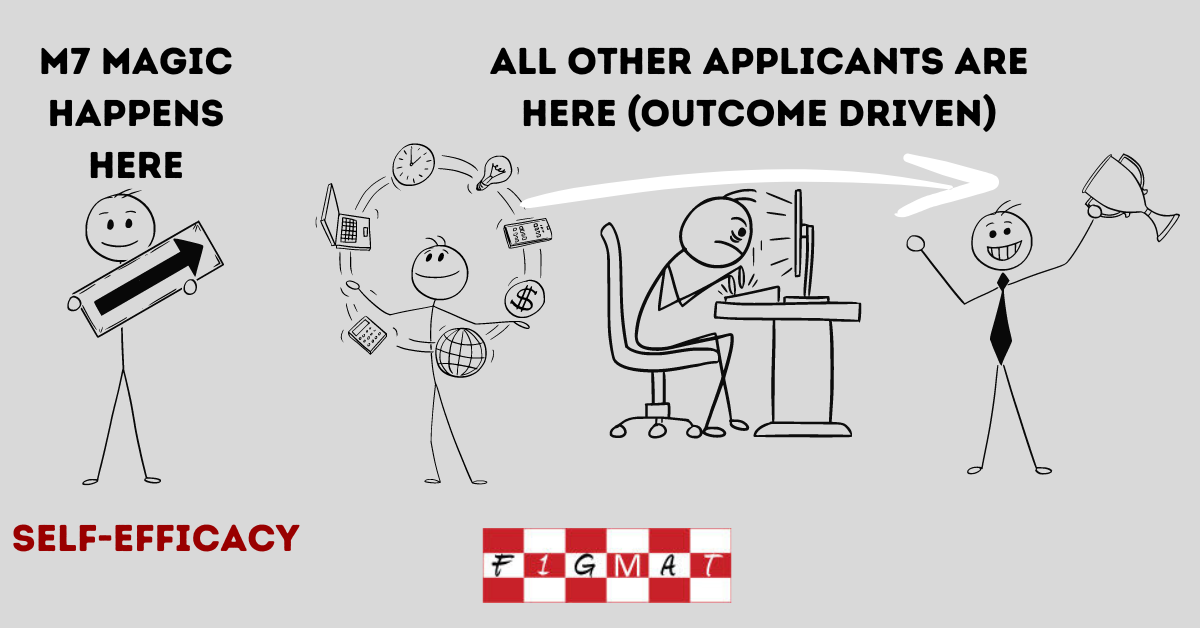
For gaining admission to M7 schools, self-efficacy is essential.
I have advised applicants who were extremely happy to gain admission to T15 or T10 school to push their limits.
Don’t be satisfied with the carrot.
Push and see where you can reach.
Admission Consultant’s Note
M7 Admissions have limited correlation with the applicant’s skills or achievements after overcoming the baseline entry criteria in GMAT/GRE, GPA and an above average career progression. Then, it is all about the ‘effort’
And when applicants listened and followed through with all the right next steps, they achieved incredible milestones. The outcome has limited correlation with their skills or achievements.
They were incredibly focused on performing at their best for their employers, acing GMAT/GRE, and writing essays for close to 1-2 and for some even three months before finally submitting. And these deliverables had several roadblocks, discouragements on the way and all through these ups and downs, the applicant kept only focusing on the highest standard that they have set for themselves.
I would say there were much, much more accomplished applicants who set their own limits and didn’t receive M7 MBA admissions.
The efficacy expectation happens before the person follows through with a behavior of persistence and pursuing excellence. The expectation is different from the outcome expectations that most applicants follow.
The Story of the Cricketer
One of the classic examples is from a popular cricketer who won the world cup – considered to be the pinnacle of achievement in a cricketer’s career. But the next day, he woke up early morning and went for his daily net practice.
The standard the person set to keep his muscle memory tuned to hit the ball at the right timing and understand the spin, the bounce of the ball and how the pitch behaved, kept his confidence high.
The reward – achieving the greatest award didn’t stop the person from continuing to perfect his skill.
For M7 admissions, I don’t think you will care about GMAT/GRE or Essays after admissions. But, high performers continue to offer value for non-profits, employers, and beneficiaries who depend on their coaching, teaching, consulting solutions, and strategies.
