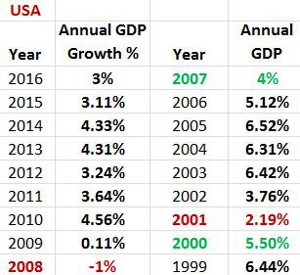
 In a span of just 10 years (1999 to 2009), the US Economy went through two booms and busts. The 2001 bust was the result of irrational exuberance that you see when new technology has not found a foothold on the market. Speculators jack up the price. Real investors play along. And then all go to the dust. 2001 was the period when taking the Business online no longer was a lottery for exponential growth but became the new reality of doing Business.
The 2008 financial meltdown nearly brought down world economies, prompting the govt. to offer a $700 billion bailout – the largest Financial Rescue plan in US history. Officially called, the Emergency Economic Stabilization Act of 2008, the plan bought non-performing loans in auto, mortgages and college tuition. The turnaround happened when the Congress passed the Recovery Act in Feb 2009. It took a year for the Act to see results when private employers outperformed govt. recruitment, adding 17.6 million jobs from March 2010 to Nov 2017 at an average of 190,000 jobs. 2008 also triggered the longest period of high unemployment rate – a trend that was reversed only in June 2015.
In such a dynamic time, it is only fair to evaluate two sought-after MBA programs that have gone on to create one of the longest lasting rivalries. If you want to measure where the economy is headed, analyze the recruitment pattern in these two top programs.
Ranking
Ranking has always been a tricky criterion for school selection. Many have less than 30% alumni survey response. However, the top 5 MBA programs are often fairly consistent in most ranking publications. This has been the case for Harvard and Stanford MBA program in the four ranking publications we have considered – Financial Times, The Economist, US News and Bloomberg BusinessWeek. 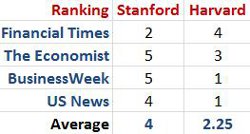
On average, Harvard outperformed Stanford by over a point and 3 quarters.
Ranking: Harvard > Stanford
Class Profile
If you feel that Stanford and Harvard are two sides of the same coin, the percentage of Humanities/Social Sciences students in the class is a clear differentiator. 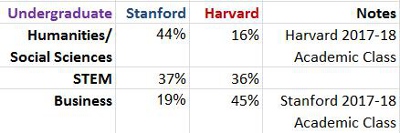
Stanford’s reputation as a sanctuary for technologists and budding Entrepreneurs is justified, but the initiative of the Stanford Humanities Institute to recruits 50 high school students for a 3-week university level course, is a signal on the strong belief the University has on the power of Humanities education. Apart from the ability to think at multidisciplinary levels, write thoughtful memos and arguments, and communicate with colleagues whose first language might not be English, Humanities degree, helped Silicon Valley Founders (LinkedIn, Pinterest, Slack, Instagram, Salesforce, AOL, and Paypal) differentiate and lead. Most career switchers from Technology and Finance prefer Consulting. Harvard clearly believes in balancing Business education with STEM to fit with this post-MBA trend.
On diversity, women candidates are finally inching closer to finding equal representation in MBA programs. The international student representation has remained 35% for most top programs, including Harvard. Stanford is a much-preferred program for International applicants, especially those with permanent residence or dual residence, who along with applicants from foreign countries added 41% representation in the latest class. 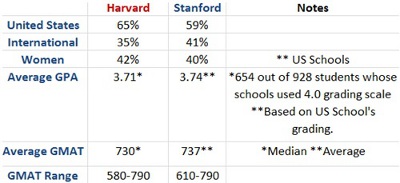
On entry criteria, both the programs have high barriers - GPA score of 3.7+ and average GMAT Score that is 737 for Stanford, and a 730 median for Harvard although the latter accept applicants with relatively lower GMAT Score (low 600s if the experience and leadership compensate).
International Students: Stanford > Harvard
Women: Harvard > Stanford
GMAT Score: Stanford > Harvard
GMAT Range: Harvard > Stanford
Course Structure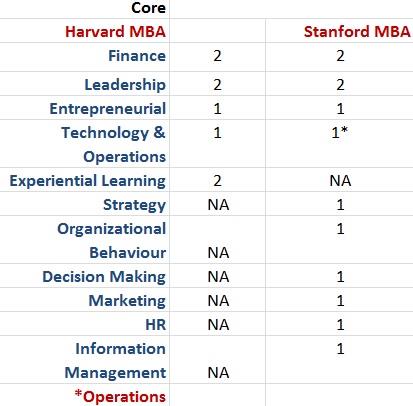 Business Schools have been experimenting with flexible and traditional cores. Stanford has a traditional core structure with courses in Finance, Leadership, Entrepreneurship, Strategy, Organizational Behaviour, Decision Making, Marketing, HR and Information Management incorporated into the mandatory schedule.
Harvard is strategic with Finance, Leadership, Entrepreneurship, and Technology & Operations incorporated in the core while offering students hands-on experience early on in the first couple of terms itself.
Stanford MBA has 10 elective themes compared to Harvard’s 9. But if you watch closely, there are six overlaps:
For Stanford vs. Harvard MBA Full Analysis: Download Comprehensive MBA Research Guide

• Business-Minded Essay: Please reflect on how your choices have influenced your career path and aspirations. (up to 300 words)
• Growth-Oriented Essay: Curiosity can be seen in many ways. Please share an example of how you have demonstrated curiosity and how that has influenced your growth. (up to 250 words)
• Leadership-Focused Essay: What experiences have shaped how you invest in others and how you lead? (up to 250 words)
Download F1GMAT's Harvard MBA Essay Guide (20+ Essay Examples & 300+ Pages of Essay Writing Wisdom)

Essay A: What matters most to you, and why? (650 Words)
Essay B: Why Stanford? (350 Words)
Optional Question: Think about times you’ve created a positive impact, whether in professional, extracurricular, academic, or other settings. What was your impact? What made it significant to you or to others? (600 Words) (200 words – each example)
Download F1GMAT's Stanford MBA Essay Guide
(24+ Sample Essays & 300+ Pages of Essay Writing Wisdom)
 About the Author
I am Atul Jose, Founding Consultant of F1GMAT, an MBA admissions consultancy that has worked with applicants since 2009.
For the past 15 years I have edited the application files of admits to the M7 programs: Harvard Business School, Stanford Graduate School of Business, the Wharton School, MIT Sloan, Chicago Booth, Kellogg School of Management, and Columbia Business School, together with admits to Berkeley Haas, Yale School of Management, NYU Stern, Michigan Ross, Duke Fuqua, Darden, Tuck, IMD, London Business School, INSEAD, SDA Bocconi, IESE Business School, HEC Paris, McCombs, and Tepper, plus other programs inside the global top 30.
My work covers the full MBA application deliverable: career planning and profile evaluation, application essay editing, recommendation letter editing, mock interviews and interview preparation, scholarship and fellowship essay editing, and cover letter editing for funding applications. Full bio with credentials and admit history is here.
I am the author of the Winning MBA Essay Guide, the best-selling essay guide covering M7 MBA programs. I have written and updated the guide annually since 2013, which makes the 2026 edition the thirteenth.
The reason I still write and edit essays every cycle: a good MBA essay carries a real applicant's voice. Writing essays for F1GMAT's Books and Editing essays weekly is how I stay calibrated to what current admissions committees respond to.
Contact me for school selection, career planning, essay strategy, narrative development, essay editing, interview preparation, scholarship essay editing, or guidance documents for recommendation letters.