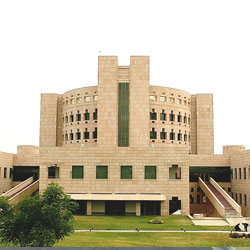
 Indian School of Business (ISB), Hyderabad is one of the most renowned B-schools in the Asian region. While a lot has already been said about ISB’s infrastructure, the quality of its faculty, and its affiliation with other top b-schools, this article seeks to present an insider’s view of some of the other things that make ISB a great school to attend.
Social initiatives: ISB is host to a local chapter of the Net Impact club. This club provides students with plenty of opportunities to lend a helping hand to the needy. Some of the activities that students can participate in through this club are:
(a) Social welfare activities like organizing blood donation camps and health check-up camps. Another important event is Bandhan, an annual event where ISB students celebrate India’s Independence Day (Aug 15) with less privileged students from four Non-Government Organizations (NGOs) across Hyderabad.
(b) Management consulting and strategizing opportunities for non-profits. The club provides opportunities for giving pro-bono consulting services to non-profits. This is a great learning experience as it allows students to apply business and management principles to real-life problems. Although the consulting opportunities are only open with non-profits through this initiative, the problems that students solve may be classic business problems, ranging from improving operations to managing finances better to creating a marketing strategy. Similarly, iDiya (pioneered in 2011) is a social venture competition that allows non-profits, B-School students, and working professionals to showcase their ideas/ventures centred on social change.
(c) Strategy events and workshops for non-profits. These events give students a chance to participate in imparting skills and business acumen to non-profits. The Diffusion initiative (started in 2011) saw students come together with the Central University of Bihar to offer skill-building courses as part of a two-day workshop for non-profits. Similarly, the Social Venture Implementation initiative allows students to write a paper about the role of social enterprises in emerging markets. The aim is to provide an idea platform for alumni who want to start a social venture.
Great research: ISB has a sharp focus on research for its faculty. In fact, the promotion criteria for faculty at ISB also includes the number of publications made by faculty members in peer-reviewed journals. This also means a lot of opportunities for students to delve deeper into their areas of interest by co-authoring research papers (with faculty members), working on research projects(using the Faculty Initiated Research Project model), or just getting to know about the latest developments in their area of interest (through published research/class teaching). A list of the Centres of Excellence set up by ISB for research in different areas can be found here.
Exchange programs: Most business schools have exchange programs with other institutions, usually in different continents. ISB does too. However, what makes ISB’s exchange program an attractive proposition is the fact that the exchange programs are with some of the world’s top universities and b-schools, including Wharton, Kellogg, LBS, Darden, Fuqua, Haas, and Stern.
Leadership development: ISB offers the unique Leadership Development Programme (or LDP), which fosters initiative, teamwork, and leadership among participants. Some of the activities within this programme include a 360 degree feedback model (allowing students to identify their strengths and weaknesses and correct them), a module to hone leadership skills, and a module to improve communication and teamwork skills. While some students feel that these ‘soft’ skills are not as useful as some of the ‘hard’ skills they learn (business concepts, management principles), they realize the importance of these skills when they apply them in their jobs.
Consulting opportunities: The ISB Experiential Learning Programme (ELP) is unique in that it offers students the opportunity to work on live consulting assignments from participating firms. The programme runs parallel to the ISB academic session. Similar to the ELP, the Wharton Global Consulting Practicum (GCP) allows students to pair up with peers from the Wharton School and work on consulting Indian companies that want to enter the North American market.
 About the Author
I am Atul Jose, Founding Consultant of F1GMAT, an MBA admissions consultancy that has worked with applicants since 2009.
For the past 15 years I have edited the application files of admits to the M7 programs: Harvard Business School, Stanford Graduate School of Business, the Wharton School, MIT Sloan, Chicago Booth, Kellogg School of Management, and Columbia Business School, together with admits to Berkeley Haas, Yale School of Management, NYU Stern, Michigan Ross, Duke Fuqua, Darden, Tuck, IMD, London Business School, INSEAD, SDA Bocconi, IESE Business School, HEC Paris, McCombs, and Tepper, plus other programs inside the global top 30.
My work covers the full MBA application deliverable: career planning and profile evaluation, application essay editing, recommendation letter editing, mock interviews and interview preparation, scholarship and fellowship essay editing, and cover letter editing for funding applications. Full bio with credentials and admit history is here.
I am the author of the Winning MBA Essay Guide, the best-selling essay guide covering M7 MBA programs. I have written and updated the guide annually since 2013, which makes the 2026 edition the thirteenth.
The reason I still write and edit essays every cycle: a good MBA essay carries a real applicant's voice. Writing essays for F1GMAT's Books and Editing essays weekly is how I stay calibrated to what current admissions committees respond to.
Contact me for school selection, career planning, essay strategy, narrative development, essay editing, interview preparation, scholarship essay editing, or guidance documents for recommendation letters.