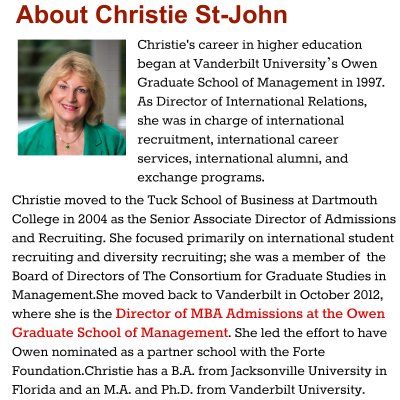
 In the first part of the Interview Series with Christie St-John, Atul Jose - the Editor of F1GMAT asks about the biggest misconception about Vanderbilt MBA, how the curriculum is structured for career switchers, and the rise of the health care specialization.
What is the biggest misconception about Vanderbilt MBA?
Many people believe that because we are in the Southern part of the United States, we are a regional school; that most of our students come from this area and also that they stay here for full-time jobs after the MBA. It is not true. Our students come from everywhere in the United States and abroad, and their post-MBA employment is just as varied in location, from San Francisco, Seattle, Washington DC, New York, Chicago, Atlanta, Boston, Miami, and points outside of the United States.
How is the curriculum structured to help career switchers?
First, our classes are set up in seven-week modules, so students finish all the core classes early and begin taking classes in their area of specialization. This prepares them for a career switch because they will have the knowledge, both from class work and from practical, hands-on experience to offer an employer. There are multiple opportunities to do small consulting projects so that students use what they are learning. In addition, students focus on leadership at Vanderbilt. Again, there are classes, but what is different is that we use certified career coaches who have previously worked with mid-level managers so they know what problems may arise in specific disciplines. The coaches may meet with our students either in a one-on-one situation or as a small group. This means our MBA students can handle problems in the workplace with empathy, structure, and guidance.
What is an accelerated “mod” system? Can students customize their core courses?
The mod schedule covers required classes and then students can start with elective classes in the first year. They can mix and match different functional areas. Most students end up with two areas of concentration and often two areas of emphasis. That is very attractive to an employer, and I have heard from our corporate recruiters that this makes a big difference. Simply stated, our students are ready to tackle most problems and projects presented to them in their internship and their full-time job. We are very proud to report that over 50% of our students returning from a summer internship has received a full-time offer at the end of the internship or a few weeks later.
What are the various concentrations available for Full-time MBA candidates?
The main concentrations are finance, accounting, marketing, operations & analytics, strategy, health care, and human & organizational performance.
How can students get a taste of the concentrations before committing to one specialization?
They all have to take one class in each functional area – that is what a Master of Business Administration is supposed to be. During the course, one learns about all the functional areas of a corporation and how they work together. Then students can decide which area they like best or which one will lead them to their desired career goal.
Can students choose multiple concentrations?
Yes, and most do at least two concentrations, such as finance and strategy, or operations and health care, or marketing and human & organizational performance. Some students do as many as three concentrations!
How does the Leadership Development Program (LDP) integrate into the MBA program?
As mentioned above, this is optional, but over 85% of our students choose to participate in the LDP. They take the Hogan assessment during orientation, then go over the results with a staff member in the Leadership office. After that the student decides what to work on – developing their personal leadership plan, working on areas of improvements, or strengthening their best characteristics. They also start thinking about their career goals and what kind of company/environment would be best for them. They may either continue with staff coaching, peer coaching, or select working with an executive coach. The Leadership Development program is not just one class and a coaching session; it lasts throughout the two years of the MBA program and is also offered to our alumni.
What are the various hands-on learning opportunities for the MBA candidates?
There are so many projects available that it is often hard to choose what to work on. There are short-term projects with local companies, startups or nonprofits, or longer term consulting projects with a larger problem or issue to resolve. Again, these are with local, national or international organizations. For example, our Consulting Club works more on local company projects—some of which may be extended depending on the results of the work.
The Turner Family Center for Social Enterprise works primarily with non-profit or NGOs, locally, nationally and internationally. Because there are so many health care companies in Nashville, Students in the Health Care Concentration have a wide variety of projects to work during their two years.
Vanderbilt has stood out as a favorite for anyone planning to get into Healthcare. What is the origin story of the Health Care MBA?
Nashville originated as an insurance town, so there are any number of large insurance companies here. Because Vanderbilt is a leading tier-one research university, it is natural that health-related companies and medical device manufacturers would situate their headquarters here. There are so many hospitals in Nashville that hospital administration entities, such as HCA, are always searching for great candidates. The growth in entrepreneurship in the areas of medical devices, pharma, or technology related to health care has ensured that Nashville is the place to be for those wanting a health care focus. There are over 350 companies related to health care in Nashville and outlying suburban areas.
Who should choose Vanderbilt Health Care MBA?
The Health Care MBA can be the right degree for anyone interested in health care administration, services or policy. There are some fascinating courses that delve into many of the different facets of health care, and often the choice of the employer may depend upon whether one wishes to continue on the same path but with promotion, or whether one wishes to change direction completely yet remain in the health care arena.
Learn more about Vanderbilt MBA Curriculum