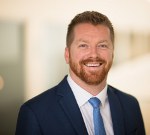
 In the first part of the interview with Mark O’Brien - the Associate Director of MBA Recruitment at the University of Oxford, Saïd Business School, we discuss the biggest misconception about Oxford MBA, the teaching tools at the MBA program, the unique integrative module and how Oxford MBA students can customize their curriculum.
What is the biggest misconception about Oxford MBA?
We aim to be a world-class business school community, tackling world-scale problems. Many people assume that our vision is fulfilled purely through our graduates who go on to work in the social impact space, but it is just as important that the majority of our community who are working in the more traditional MBA sectors believe in the School’s mission and play their part in tackling the problems we face in business and society.
We are a dynamic school balancing the spirit of a young, and innovative class, with the values of an 800-year-old world-class university. The Business School itself was 21 years old in 2017. The Oxford MBA attracts candidates from 60 different nationalities, who come from a wide range of industries and functions.
We are incredibly proud that over 10% of our class graduating in 2016 took up roles, or started their own business in the social impact space.
This aligns with some of the unique areas of core courses, electives, integrative modules and projects and we attract many students who have a background in or are interested in switching in the social impact sector. However, the biggest sector for our recent graduates was Finance, with over 25% of the class taking up roles in this area, followed by just over 23% going into Consulting. Technology is a growing and popular sector, with 22% of the class going into this area.
What teaching methodology is adopted at Oxford Full-time MBA?
Our MBA programme uses a number of different teaching methodologies. Students are expected to contribute to class discussions and share their unique experiences with their peers. This is certainly not the type of programme where students just take notes and sit exams! It is very interactive, and there are numerous group projects in the core and elective courses. The subjects typically consist of lectures (40%), team projects (25%), case studies (25%) and simulations (10%).
The integrative module is a unique part of Oxford MBA curriculum designed to develop cross-functional expertise. Is it an elective? How should students choose one of the three orientations?
There are three integrative modules as part of the Oxford MBA that explore cross-cutting themes that relate to the world-scale challenges shaping today's business environment; Entrepreneurship, Global Rules of the Game and Responsible Business. The integrative modules are part of the core curriculum, not electives, so all students will engage with the three topics throughout the academic year.
We firmly believe that these modules are essential for all future business leaders and they are reflected in other areas of the programme such as guest-speakers, non-programme events, student-run conferences, and competitions.
How should an International MBA candidate customize the curriculum to find opportunities in UK, post-MBA?
We offer students the opportunity to customize their content through the elective portfolio, as well as offering a choice of options in the summer term.
Students take a minimum of seven electives in the second and third terms, choosing from about 30 – 40 courses across numerous subject areas. 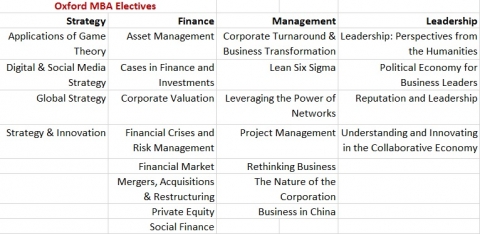
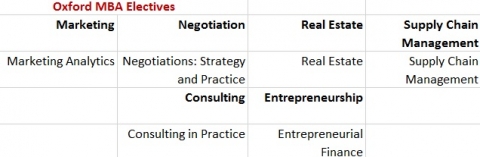
In the summer term, students can opt to take two extra electives.
Alternatively, students can take an internship during the summer period, which gives them more hands-on experience in their desired industry.
The third option is the Strategic Consulting Project (SCP), where students work in groups of five or six on a consulting project for a corporate sponsor. Projects take place all over the world with a wide range of companies, charities, non-profits, and start-ups.
This ability to customise their programme gives students the chance to focus on routes that will help them reach their personal post-MBA goals; whether that is to accelerate their career in their current organisation or industry, to transition to a new industry or region, or start up their own venture. About Mark O’Brien
Mark is the Associate Director of MBA Recruitment at the University of Oxford, Saïd Business School. He has been with the School since 2016 and has spent a number of years working with aspiring MBA applicants.
Get in touch with Mark (LinkedIn,Call/Email )
Reference
Oxford Full-time MBA
Brochure
How to Apply
Strategic Consulting Project