If we must find the most lasting business school rankings, Financial Times (FT), US News, and The Economist feature in most consultant’s decision-making tools.
As a publication ourselves, we understand the time-sensitive nature of the surveys. Schools might not be able to complete all the requirements of each publication’s surveys. Some schools strategically opt-out of one ranking to feature in another and use the results to market aggressively to MBA applicants. The game of ranking is flawed, and as one dives deep into the ranking methodology and factors, the flaw becomes obvious.
The Lack of Uniformity
The methodology is not based on universally accepted parameters for qualifying MBA programs and top schools. However, all the rankings values ‘increase in salary’ and ‘post-MBA salary’ to varying degrees. Understanding the influence of this data on the ranking will help you choose the most relevant ranking. For many, an increase in salary might not be a bigger criterion. A change in job function or achieving a career goal (that you brainstormed in essays) would be of immense value to you. Despite the qualitative motivations, top schools attract employers who can shelve out $135,000 to $150,000 base salary.
Understanding what you want from a program and then choosing the appropriate ranking that meets this requirement is a better way to gauge a school. But we have yet to see an applicant who is not targeting at least a 50-75% increase in base salary.
Accreditation
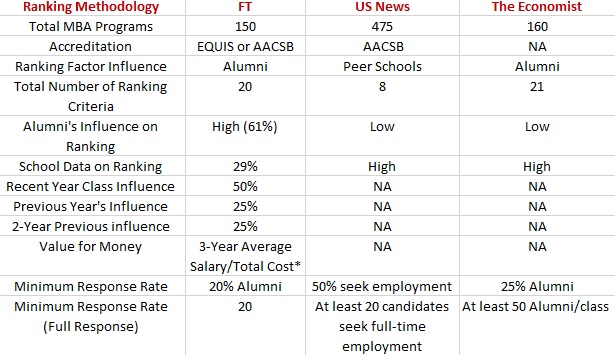
Financial Times invites programs that are either EQUIS or AACSB accredited, whereas US News only selects programs with AACSB accreditation, leaving out several European schools with credible track records. The Economist has not mentioned any such criteria in the ranking methodology.
The number of programs invited – 150 to 160 range for the FT and the Economist restricts the ranking to the traditionally performing schools. US News takes the risk of inviting a bigger pool (475), allowing the start-up programs with limited market dominance to have a shot at the ranking. The AACSB accreditation ensures that the quality is not compromised.
Wider Reach: US News > The Economist > FT
US-based Schools: US News > The Economist > FT
Global Schools: FT > The Economist > US news
Ranking Factor – Most Influence
At the core of the rankings, there are surveys that are sent to current students or alumni. The influence of the program managers/alumni relations officers over the timely completion of the surveys with regular follow-up determine the fate of most top programs. Persuasive Communication, Team spirit, and influence of the marketing team is a big hidden factor in getting the right response.
Each publication approaches the survey in a completely different way.
Financial Times value the opinion of the Alumni (past three years) the most.
For US News, 25% of the ranking score is influenced by the rating of peer schools.
The Economist prefers the opinion of the Alumni but not to the same extent as Financial Times.
Financial Times clearly dominates when it comes to finding the opinion of the ‘customer’ who is leveraging the brand value of the ‘MBA’ program in the market in the short-term (1-2 years) and the mid-term (3-5 years). The approach evens out the change in the job market in the short-term like the IT bust of 2001 or the Financial meltdown of 2008.
Survey Audience (Effectiveness): Financial Times > The Economist > US News
Response Rate
It is a logistical nightmare to capture the opinions of the most influential Alumni. They are busy or won’t have the attention or don’t value the impact the program had on their career trajectory. For applicants, it is even more challenging to decipher the reason for the low response rate. When was the last time you responded to a survey that eats up 30 minutes to 2 hours of your life?
Publications understood our laziness to fill out forms and created a response rate criterion of 20% (FT) and 25% (The Economist). US News decided to leave out the survey response rate and look at the employment data to make a call on whether the program is effective. The publication goes by the assumption that “Less than 50% seeking employment means the program doesn’t have immediate value”. The Economist does a better job at the response rate and only accepts programs that have at least 50 alumni from a graduating year responding to the survey.
Response Rate: The Economist > FT > US News
Note: US News’ strategy is effective, but in the ranking, the response rate is paramount in understanding the participation. Poor participation could be from dissatisfaction in the program.
Ranking Factors
Salary Increase: Salary is an influential component in the ranking. Financial Times has made the data as the basis for most of its ranking factors. The Economist takes a step further and collects the Salary Increase with and without the bonus to confirm the effectiveness of the program in attracting excellent offers.
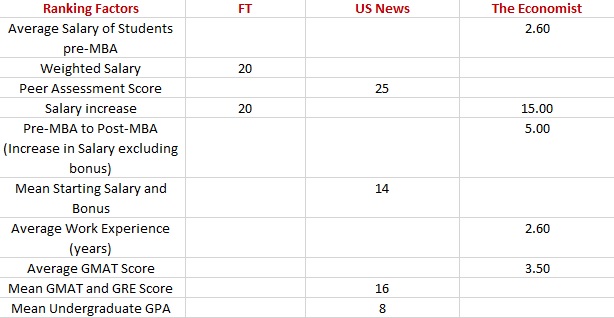
Base Salary Increase: The Economist > Financial Times
Salary Increase: The Economist > Financial Times
Financial Times takes the Alumni data to measure the salary increase over a period of 3-years, giving us a peek into the earning potential of the Alumni in each program, but if you are looking at immediate value, the Economist and US news offer that data. The only problem with US news is the use of the mean starting salary. Since a typical class has outlier with the top 5% earning proportionally more than the median and the lower 5% opting to chose career with low earning (entrepreneurship in the short-term and non-profit), the data might give the wrong impression of the effectiveness of a program. Financial times have understood the problem and consider the weighted salary after eliminating the outliers.
Alumni Salary Increase (3-Years): Financial Times > The Economist > US News
Quality of the Incoming class
For a holistic evaluation of the incoming class, The Economist has done a better job as GMAT and Experience often compensate for the average performance in the undergraduate degree. The US News continues with a traditional approach where the applicant’s past performance academically and an assumption that the experience translates to job performance is built into the evaluation.
For those traditional applicants who believe that choosing programs where the class GMAT and GPA determine the quality, US News and the Economist validates this belief. Financial Times has ignored the incoming class’s performance along the two lines.
Incoming Class (Traditional Evaluation): US News > The Economist > Financial Times
Current Student’s Opinion
Since schools don’t accept applicants from a monolith, the probability that each year the characteristics of a class and the temperament varies is also high. Some years the opinion of the current students on whether the program meets the expectations would fluctuate widely, while in other years, it would remain closer to the median.
Only The Economist with 13.5% towards its ranking factor has measured the mood of the current students with five factors: Student rating of culture and classmates, Student Rating of Alumni Network, Student rating of program and range of electives, Student assessment of facilities and other services, and Faculty rating by students.
Current Student’s Opinion: The Economist
Recruiter Assessment Score
Although the combination of the post-MBA salary, and employed within three months are a good indicator of the reputation of the program among recruiters, US news is the only ranking that has allocated 15% of its total ranking factor for Recruiter Assessment Score in addition to considering mean starting salary & bonus, and employment rate at graduation.
Recruiter’s Perception of the Program: US News
Value for Money
The value for money could be measured from a pure ROI or from the goals achieved since graduating from an MBA. Although we understand that the idealistic and ambitious goals that we help applicants help capture through our essay review service, might be different from the goals that applicants set once they experience the post-MBA functions through internships, career progression, aims achieved and the impact of the career service team are valuable reference point to evaluate schools. Since the Financial Times rely heavily on the Alumni’s opinion, applicants could filter schools with the greatest value for money. Consider the parameter with caution as most top schools expect the applicants to be self-driven and facilitate their own opportunity through aggressive networking.
Value For Money: The Financial Times > The Economist > US News
Holistic Evaluation
The Financial Times has taken the ranking with a holistic approach by considering factors that contribute towards the overall learning experience (faculty with doctorates, female faculty), diversity (students, faculty, international), international reach (faculty, board, mobility, experience), research prowess (research rank) and corporate social responsibility, contributing an impressive 43% towards the overall rank.
Holistic Ranking: The Financial Times > The Economist > US News
Reference