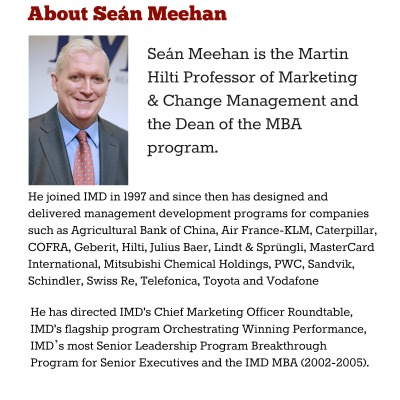
 In the second part of the interview, we learn how IMD pioneered the International Consulting Project, the career motivation of the MBA class, post-MBA roles, and the value the program offers for career switchers.
IMD was first on the scene with ICPs almost 40 years ago, and companies come back to us year after year as they really appreciate the value of the insights they gain from our MBAs.
The ICPs take place in the second half of the program and are a great platform for all of our participants to put into practice everything that they have learned during the year and realise how far they have come. It is a step back into the real world. They are no longer working within the safety of the IMD bubble but are working on a real strategic challenge faced by a company that expects solid deliverables.
We typically select 15 – 18 companies that cover a wide range of industries, issues, and geographies.
Projects range from market entry strategy, digital business transformation to restructuring organization.
How can career switchers customize the IMD MBA curriculum to get maximum value?
Our MBA program is at the center of our network and ecosystem comprising 50 faculties, over one hundred coaches, and 9,000 executive alumni annually. We construct specific opportunities for our 90 participants to explore avenues and build customized supporting networks to enable them to choose the right path.
The entire class of 90 follows the same core program, but a large part of that program consists of team project work and one-on-one leadership coaching which focuses on their specific individual development.
MBAs start the year helping local start-up companies to develop their business plan, marketing and finance options.
The projects cover diverse sectors and issues, which are presented to the class so that they can choose a potential fit with their interests and goals. Similarly, the 2-month International Consulting Projects offer them the opportunity to choose out of 15-18 diverse multinationals, and to work with them to resolve a current issue.
These projects frequently lead to job offers by the end of the program and allow our participants to gain experience in a new industry or function or make a strong connection with a company that might be of particular interest to them.
Finally, at the end of the year, when they should be very clear on exactly what their career goal is, we offer a wide range of electives, which we change each year to ensure that we are addressing current topics, trends and class needs.
What roles do career enhancers typically accept post-MBA?
Again, the diversity and strong prior experience of our participants play an important role here.
Recruiters come to IMD with the knowledge that on average our MBAs already have an average of 7 years of experience, so if they are looking to enhance their career, they will typically be looking for a wider geographical responsibility or a larger business unit.
Many of our participants are already in a management or even director role, but often want to move into a position where they feel they can make more impact.
Examples of post-graduate titles from the 2016 class include:
• CEO* Program Associate for Siemens in Germany
• CEO of IPG in Japan
• CFO for APT Advanced Potash Technologies in the USA.
What role does the career service team play in matching the candidate with the right employer? How is the MBA class trained for interviews (case interviews) and job search?
We consider career management skills to be just as important as graded topics such as marketing and accounting and therefore incorporate the Career Services stream into the program schedule.
With a class size of 90, we can be very personalized in our approach and offer individual career coaching and one-on-one advice for everyone.
Recruiters hire for leadership potential, and we have the advantage of being able to offer tailored solutions to companies so that they connect with the right mix of participants for the roles they want to fill.
Workshops, panel discussions, and projects with specialists, alumni and HR executives take MBAs from their vision, goal and elevator pitch all the way through the skill range to negotiating their final salaries.
How is the post-MBA career placement influenced? Do opportunities in Switzerland and Europe affect the offers? What percentage of the class found opportunities in Europe, particularly in Switzerland?
The biggest influence is obviously the market itself and in our case the global market. Our graduates come from all over the world, so while some might want to build on their European experience, the majority will actually use their international expertise in a position where they can provide the most impact for the hiring company.
The end result varies from year to year.
In 2016 the number staying in Europe was 76%.
In 2018 70% of the class have worked in emerging markets and wished to return.
Pharma and Manufacturing are other popular post-MBA industries. Are the offers mostly from local recruiters?
Again, the global expertise we have in the class results in a mix of both global and local opportunities, depending on the market and the companies themselves.
Many headquarters are actually based here in Switzerland, which gives us an added advantage, and the local eco-system itself includes med-tech and biotech companies, start-ups and international research projects like the BrainProject.
Reference
ICP - Previous projects
IMD MBA Schedule
IMD MBA Career Service