Top 5 Tips to Improve your GMAT Critical Reasoning Score

Top GMAT Critical Reasoning Score ImprovementGMAT Critical Reasoning Questions comprises nearly 1/3rd of all the Questions in the GMAT Verbal Section. It is important that you learn to analyze and identify various parts of the arguments. Follow these 5 Tricks and you will improve your GMAT CR Score:

1. Understand GMAT Critical Reasoning Definitions

Know the definition for terms like assumption, inference, evidence, conclusion, logical flaw, paradox, etc., like the back of your hand. As you go through practice tests, write down any words in the argument, question stem, or answer choice that confuse you – and then look them up!  When you have the essential definitions down, you can jump into arguments much more quickly — and you won’t waste any time second-guessing what a question is asking you to find.

2. Identify parts of CR Passages

If you’re having a hard time sorting out the meaning of a passage, take a moment to identify its conclusion and the evidence (statements of fact) and assumptions (unstated ideas) it uses to make that conclusion (the conclusion will often be signaled by words like “as a result” or “therefore”). Once you break down an argument into its component parts, it’s easier to see what purpose each component serves. This structural approach is key when you’re asked to strengthen, weaken, or paraphrase specific claims.

3. Correlation is not the same as causation

This is a common logical flaw, and it occurs when an argument concludes that one event caused another, based only on the evidence that the two occurred at the same time or one after another. Don’t be fooled! The GMAT will throw the same flawed logic at you again and again to test your knowledge of sound reasoning. If you know the go-to flaws ahead of time, you can jump to the right answer more quickly (and avoid the traps more easily!).

4. Beware of Opposite answer choices

If a question asks you for a statement that best weakens an argument, beware of answer choices that do the exact opposite (i.e. strengthen the argument). Opposite answers are actually incredibly tempting because they mirror correct answers in force. The test-makers bank on the fact that your attention will slip just for a second and you’ll pick the opposite of the right choice. If you’re on the lookout for this trick, you’ll be less likely to fall for it.

5. Learn about the most frequently used Methods of Reasoning

Arguments cite many types of evidence, but certain methods of reasoning are more effective than others and thus more commonly used on the GMAT. An author might advance her points by citing an authority (like a study or scholar) or providing an analogy (appealing to a similar situation). Common methods of countering an argument including noting ulterior motives or demonstrating a logical inconsistency.  This is another example where identifying the structure of an argument can save you time. If you understand an author’s method of reasoning, it’s easier to identify where the argument is flawed — and how you could strengthen or weaken it if a question asked you to do so.

About the Author 

Atul Jose - Founding Consultant F1GMAT

I am Atul Jose - the Founding Consultant at F1GMAT.

Over the past 15 years, I have helped MBA applicants gain admissions to Harvard, Stanford, Wharton, MIT, Chicago Booth, Kellogg, Columbia, Haas, Yale, NYU Stern, Ross, Duke Fuqua, Darden, Tuck, IMD, London Business School, INSEAD, IE, IESE, HEC Paris, McCombs, Tepper, and schools in the top 30 global MBA ranking. 

I offer end-to-end Admissions Consulting and editing services – Career Planning, Application Essay Editing & Review, Recommendation Letter Editing, Interview Prep, assistance in finding funds and Scholarship Essay & Cover letter editing. See my Full Bio.

Contact me for support in school selection, career planning, essay strategy, narrative advice, essay editing, interview preparation, scholarship essay editing and guiding supervisors with recommendation letter guideline documents

I am also the Author of the Winning MBA Essay Guide, covering 16+ top MBA programs with 240+ Sample Essays that I have updated every year since 2013 (11+ years. Phew!!)

I am an Admissions consultant who writes and edits Essays every year. And it is not easy to write good essays. 

Contact me for any questions about MBA or Master's application. I would be happy to answer them all 

Mastering GMAT Critical Reasoning (2023 Edition)


Chapters
1) Introduction   
2) 6 Step Strategy to solve GMAT Critical Reasoning Questions   
3) How to overcome flawed thinking in GMAT Critical Reasoning?   
4) 4 GMAT Critical Reasoning Fallacies   
5) Generalization in GMAT Critical Reasoning   
6) Inconsistencies in Arguments   
7) Eliminate Out of Scope answer choices using Necessary and Sufficient Conditions   
8) Ad Hominem in GMAT Critical Reasoning   
9) Slippery Slope in GMAT Critical Reasoning   
10) Affirming the Consequent – GMAT Critical Reasoning   
11) How to Paraphrase GMAT Critical Reasoning Question   
12) How to Answer Assumption Question Type   
13) How to Answer Conclusion Question Type   
14) How to Answer Inference Question Type   
15) How to Answer Strengthen Question Type   
16) How to Answer Weaken Question Type   
17) How to Answer bold-faced and Summary Question Types   
18) How to Answer Parallel Reasoning Questions   
19) How to Answer the Fill in the Blanks Question   
Question Bank   
Question 1: 5G Technology (Inference)   
Question 2: Water Purifier vs. Minerals (Fill in the Blanks)   
Question 3: Opioid Abuse (Strengthens)   
Question 4: Abe and Japan’s Economy (Inference)   
Question 5: Indians and Pulse Import (Weakens)   
Question 6: Retail Chains in Latin America (Assumption)   
Question 7: American Tax Rates – Republican vs. Democrats (Inference)   
Question 8: AI – China vs the US (Weakens)   
Question 9: Phone Snooping (Strengthens)   
Question 10:  Traditional Lawns (Assumption)   
Question 11:  Appraisal-Tendency Framework (Inference)   
Question 12:  Meta-Analysis of Diet Trials (Weakens)   
Question 13:  Biases in AI (Strengthens)   
Question 14:  Stock Price and Effectiveness of Leadership (Inference)   
Question 15:  US Border Wall (Weakens)   
Question 16:  Driverless Car and Pollution (Assumption)   
Question 17:  Climate Change (Inference)   
Question 18:  Rent a Furniture (Weakens)   
Question 19:  Marathon Performance and Customized Shoes (Weakens)   
Question 20:  Guaranteed Basic Income (Assumption)   
Question 21:  Brexit (Infer)   
Question 22:  AB vs Traditional Hotels (Assumption)   
Question 23:  Tax Incentive and Job Creation (Weakens)   
Question 24:  Obesity and Sleeve Gastrectomy (Inference)   
Question 25:  Recruiting Executives (Weaken)   

Answers with Detailed Explanation


Essential GMAT Reading Comprehension Guide (2023 Edition)


Chapters

  • Collecting and Interpreting Facts: GMAT Reading Comprehension    

  • Effective Note-taking for GMAT Reading Comprehension   

  • 5 Questions to Speed up Summary Creation   

  • Mastering GMAT Reading Comprehension: 3 Best Practices   

  • How to Remember Information   

  • How to improve comprehension by Questioning the Author   

  • How to Read Faster   

  • How to Answer GMAT Reading Comprehension Title question

  • How to Answer GMAT Reading Comprehension Main Idea Question   

  • How to Answer GMAT Reading comprehension inference question   

  • How to Answer GMAT Reading Comprehension Purpose Question   

  • How to Answer GMAT Reading Comprehension Detail Question   

  • How to Answer the GMAT organization of passage Question   

  • How to Improve GMAT Reading Comprehension Score?   

Passage #1: Protein-Rich Diet    Passage #2: Pregnant Women and Stress Management   
Passage #3: F Losing Momentum   
Passage #4: Conservatives and Automation   
Passage #5: Collaboration, Team size and Performance   
Passage #6: Effective Altruism   
Passage #7: Loneliness Epidemic   
Passage #8: Space Exploration   
Passage #9: Lab-Grown Meat   
Passage #10: Minimum Wage in the US   
Passage #11: AI and Creativity   
Passage #12: Bias Against Healthcare in Developing Economies   
Passage #13: Legacy Admissions   
Passage #14: Plastic Ban and alternatives   
Passage #15: Underestimating Homo Sapiens   
Passage #16: Conspiracy Theories   
Passage #17: Relative Poverty   
Passage #18: Why Paintings are expensive   
Passage #19: US Obesity Epidemics   
Passage #20: The Future of Advertising   
Passage #21: Breaking Large Companies   
Passage #22: Helicopter Parenting   
Passage #23: Future of Democracy   
Passage #24: Technology and Global Citizenship  

Passage #25: Morality and Investment   

Answers: 157 to 294

Pages: 295

Questions: 100+

Download F1GMAT's Essential GMAT Reading Comprehension Guide (2023 Edition)


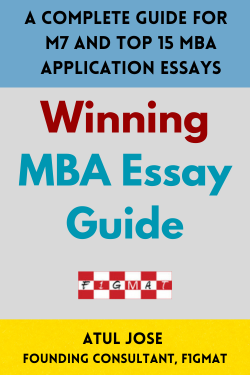
Winning MBA Essay Guide - A Complete Guide for M7 and Top 15 MBA Application Essays 


F1GMAT's Winning MBA Essay guide will teach you how to transform your essay into a life journey with trials and tribulations that will move the admission team.

+ Over 245 Sample Essays (Read Previews of F1GMAT's Winning MBA Essay Guide Sample Essays here)

+ Top 15 MBA Programs (Harvard, Stanford, Wharton, Columbia, Booth, MIT, Kellogg, Yale, Haas, Darden, INSEAD, LBS, NYU Stern, Tuck, Duke Fuqua, Ross)
+ The Art of Storytelling 
+ Leadership Narratives
+ Review Tips
+ Persuasion Strategies
+ The Secret to "unleashing" your unique voice
+ How to prepare and present for the Video Essay
+ How to write about your Strengths
+ How to write about your Weaknesses


Want to try the individual school Essay Guides before upgrading to the Winning MBA Essay Guide? Try below.

F1GMAT's Essay Guides

Want to read the Essay Examples before purchasing the Essay Guides? 

Not sure if an MBA Program is right for you? See our Premium Research.

F1GMAT Premium

Salary Trends 

Do you want to work with the expert consultant who has guided applicants to M7 and T20 MBA admissions?  Sign up now!

F1GMAT's Services 

Get Exclusive Events, Advice and Trends in your Inbox