Ever heard of a Math problem that you actually don't have to solve. If you have just started your GMAT prep, then this can be confusing. Don't worry! With some practice, your mind will be trained to think like a DS Wizard. Follow these 10 tips and you will be on your way to mastering GMAT Data Sufficiency.
1. Familiarize with the Answer Choices
No excuses: On Data Sufficiency, they’re always the same! Know in the blink of an eye what choice C is. On test day, if you find that Statement 1 is insufficient, be able to cross out choices A and D without hesitation.
Data Sufficiency questions are not the same as your regular "Find the value of x" question. GMAT DS Questions require you to adjust in your approach to Math Problems. You are not primarily concerned with the final answer, but rather whether you have enough information to get you to that answer. For example, if you’re asked to find the value of x, and a statement tells you that 300x + 257 = 1345, you know that this statement is sufficient, because you can perform arithmetic on that equation to isolate x.
During GMAT Preparation, Critical Reasoning and Data Sufficiency sections require a great deal of adjustment compared to GMAT Reading Comprehension and Sentence correction. The linear thinking that involve variables, data substitution, rules, and logical thinking might not completely work for 700+ GMAT CR and DS sections. Here is Why!
To score 700+ on the GMAT, test takers must develop a strategy to answer the Quant questions in 2 minutes and Verbal questions in 1 minute & 20 seconds.
Data sufficiency questions can be solved well within the 2-minute mark, most likely in 1 minute and 30 seconds if the conditions and question are rephrased.
1) There are two ticket types in each screen – Silver and Gold, Silver sold at $35 - $10 less than Gold 2) The total number of seats in each screen was 500
A. Statement (1) ALONE is sufficient, but statement (2) alone is not sufficient. B. Statement (2) ALONE is sufficient, but statement (1) alone is not sufficient. C. BOTH statements TOGETHER are sufficient, but NEITHER statement ALONE is sufficient. D. EACH statement ALONE is sufficient. E. Statements (1) and (2) TOGETHER are NOT sufficient.
Q) Is the sum of all the numbers between prime numbers x and y an even or an odd number?
1) x = 3 y = 31 2) y is the largest two digit number, x is even
A. Statement (1) ALONE is sufficient, but statement (2) alone is not sufficient. B. Statement (2) ALONE is sufficient, but statement (1) alone is not sufficient. C. BOTH statements TOGETHER are sufficient, but NEITHER statement ALONE is sufficient. D. EACH statement ALONE is sufficient. E. Statements (1) and (2) TOGETHER are NOT sufficient.
Once GMAT test takers have learned about the fundamental concepts tested in the exam, focus should be on saving time for each question. GMAT Data sufficiency follows a format where a question is followed by two statements, labeled as (1) and (2), and five answer choices. Process of Elimination techniques will allow you to complete the GMAT DS questions in less than one and half minutes. Learn more about GMAT Data Sufficiency POE Technique.
GMAT test takers are more inclined to pick Answer Choice C in Data Sufficiency just as they would choose choice A in Sentence Correction. This trap in assumption is obvious to test creators, and they formulate the two statements carefully to force you to pick the wrong answer choice.
Learn the concepts behind volume and surface area before you start solving GMAT Solid geometry problems. All solid geometry problems come down to this - length, breadth and height.
For data sufficiency questions, look out for values of l, b and h. if any of them are missing then it would be easy to eliminate answer choices. Here is How!
Even if you fear statistics by its reputation, it is one of the easiest sections in the GMAT because a standard set of questions is asked and anyone who understands the fundamentals that I shall describe will be able to ace the questions. Learn the GMAT Statistics Fundamentals.
True to their name, Data Sufficiency questions ask you to determine when you will have enough information to make a conclusive decision. In doing so, these questions can assess your ability to plan ahead for a task; to elicit an effective return-on-investment (remember, you can’t use both statements if one of them is, alone, sufficient), to find flaws with conventional wisdom, and to think flexibly. Find out why contradicting yourself can lead to errors in GMAT Data Sufficiency.
Perhaps no GMAT item is as symbolic of the test as is a Data Sufficiency question. It is an iconic question format, unique to the GMAT and true to the aims of this specific test: to reward those who show the higher-order reasoning skills that will lead to success in business.
Data Sufficiency questions are supposed to be hard; more so than any other question type they tend to represent a chess match between you and the author, as the author has two chances to get you to make a mistake. Find out how to spot obvious answer trap.
Collecting and Interpreting Facts: GMAT Reading Comprehension
Effective Note-taking for GMAT Reading Comprehension
5 Questions to Speed up Summary Creation
Mastering GMAT Reading Comprehension: 3 Best Practices
How to Remember Information
How to improve comprehension by Questioning the Author
How to Read Faster
How to Answer GMAT Reading Comprehension Title question
How to Answer GMAT Reading Comprehension Main Idea Question
How to Answer GMAT Reading comprehension inference question
How to Answer GMAT Reading Comprehension Purpose Question
How to Answer GMAT Reading Comprehension Detail Question
How to Answer the GMAT organization of passage Question
How to Improve GMAT Reading Comprehension Score?
Passage #1: Protein-Rich Diet Passage #2: Pregnant Women and Stress Management Passage #3: F Losing Momentum Passage #4: Conservatives and Automation Passage #5: Collaboration, Team size and Performance Passage #6: Effective Altruism Passage #7: Loneliness Epidemic Passage #8: Space Exploration Passage #9: Lab-Grown Meat Passage #10: Minimum Wage in the US Passage #11: AI and Creativity Passage #12: Bias Against Healthcare in Developing Economies Passage #13: Legacy Admissions Passage #14: Plastic Ban and alternatives Passage #15: Underestimating Homo Sapiens Passage #16: Conspiracy Theories Passage #17: Relative Poverty Passage #18: Why Paintings are expensive Passage #19: US Obesity Epidemics Passage #20: The Future of Advertising Passage #21: Breaking Large Companies Passage #22: Helicopter Parenting Passage #23: Future of Democracy Passage #24: Technology and Global Citizenship
Chapters 1) Introduction 2) 6 Step Strategy to solve GMAT Critical Reasoning Questions 3) How to overcome flawed thinking in GMAT Critical Reasoning? 4) 4 GMAT Critical Reasoning Fallacies 5) Generalization in GMAT Critical Reasoning 6) Inconsistencies in Arguments 7) Eliminate Out of Scope answer choices using Necessary and Sufficient Conditions 8) Ad Hominem in GMAT Critical Reasoning 9) Slippery Slope in GMAT Critical Reasoning 10) Affirming the Consequent – GMAT Critical Reasoning 11) How to Paraphrase GMAT Critical Reasoning Question 12) How to Answer Assumption Question Type 13) How to Answer Conclusion Question Type 14) How to Answer Inference Question Type 15) How to Answer Strengthen Question Type 16) How to Answer Weaken Question Type 17) How to Answer bold-faced and Summary Question Types 18) How to Answer Parallel Reasoning Questions 19) How to Answer the Fill in the Blanks Question Question Bank Question 1: 5G Technology (Inference) Question 2: Water Purifier vs. Minerals (Fill in the Blanks) Question 3: Opioid Abuse (Strengthens) Question 4: Abe and Japan’s Economy (Inference) Question 5: Indians and Pulse Import (Weakens) Question 6: Retail Chains in Latin America (Assumption) Question 7: American Tax Rates – Republican vs. Democrats (Inference) Question 8: AI – China vs the US (Weakens) Question 9: Phone Snooping (Strengthens) Question 10: Traditional Lawns (Assumption) Question 11: Appraisal-Tendency Framework (Inference) Question 12: Meta-Analysis of Diet Trials (Weakens) Question 13: Biases in AI (Strengthens) Question 14: Stock Price and Effectiveness of Leadership (Inference) Question 15: US Border Wall (Weakens) Question 16: Driverless Car and Pollution (Assumption) Question 17: Climate Change (Inference) Question 18: Rent a Furniture (Weakens) Question 19: Marathon Performance and Customized Shoes (Weakens) Question 20: Guaranteed Basic Income (Assumption) Question 21: Brexit (Infer) Question 22: AB vs Traditional Hotels (Assumption) Question 23: Tax Incentive and Job Creation (Weakens) Question 24: Obesity and Sleeve Gastrectomy (Inference) Question 25: Recruiting Executives (Weaken)
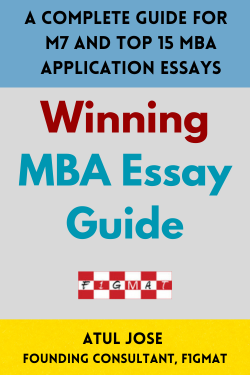
Read the Essay Guides and see how we write & edit MBA essays
Winning MBA Essay Guide - A Complete Guide for M7 and Top 15 MBA Application Essays
F1GMAT's Winning MBA Essay guide will teach you how to transform your essay into a life journey with trials and tribulations that will move the admission team.
+ Top 15 MBA Programs (Harvard, Stanford, Wharton, Columbia, Booth, MIT, Kellogg, Yale, Haas, Darden, INSEAD, LBS, NYU Stern, Tuck, Duke Fuqua, Ross)
+ The Art of Storytelling + Leadership Narratives + Review Tips + Persuasion Strategies + The Secret to "unleashing" your unique voice + How to prepare and present for the Video Essay + How to write about your Strengths + How to write about your Weaknesses
 Ever heard of a Math problem that you actually don't have to solve. If you have just started your GMAT prep, then this can be confusing. Don't worry! With some practice, your mind will be trained to think like a DS Wizard. Follow these 10 tips and you will be on your way to mastering GMAT Data Sufficiency.
 To score 700+ on the GMAT, test takers must develop a strategy to answer the Quant questions in 2 minutes and Verbal questions in 1 minute & 20 seconds.
  What was the revenue that the movie theater earned from Friday to Sunday if the occupancy rate of its three screens 1, 2, and 3 were the following?

 Learn the concepts behind volume and surface area before you start solving GMAT Solid geometry problems. All solid geometry problems come down to this - length, breadth and height.