F1GMAT · https://www.f1gmat.com/gmat-solid-geometry-rectangular-solids-and-cylinders ·
 Add F1GMAT as a preferred source on Google, opens Google in a new tab
 See more of F1GMAT's MBA admissions research in Google's Top Stories by making us a preferred source on Google.
Rectangular Solid
Learn the concepts behind volume and surface area before you start solving GMAT Solid geometry problems. All solid geometry problems come down to this - length, breadth and height. For data sufficiency questions, look out for values of l, b and h. if any of them are missing then it would be easy to eliminate answer choices.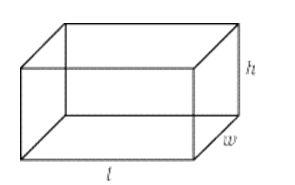
6 rectangular faces constitute a rectangular solid
The formulas you need to remember for a rectangular solid are
Volume = Length (l) x Width (w) x Height (h)
Surface Area = (2 x Length x Width) + (2 x Length x Height) + (2 x Width x Height)
"If length = width = height, that means that the rectangular solid is, in fact, a cube."
Terminologies
Vertex: Wow! quite a confusing word? Not really
Vertex = Corner
a) Vertex is the number of corners in a figure
The rectangular solid above has 8 vertices (plural of vertex), can you identify them?
b) Edge is the number of lines that you see in a diagram.
The edge is simply the lines you see in the diagram above: the line where two surfaces meet.
Cylinder
Questions that has cylinder in it are much easier. You have to focus on only two values - the radius(r) and the height(h).
If you don’t know the radius, anything that enables you to determine the radius, such as the diameter (radius = diameter / 2) or the circumference (radius = circumference / 2pi) will suffice.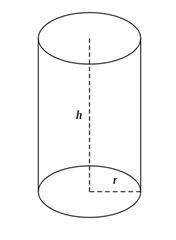
Regarding cylinders, the formulas you need to know are
Volume = area of the base circle x height = pi x (radius)2 x height
Surface Area = (2 x pi x (radius)2 )+ (pi x (diameter) x height)
Q) Let’s try a problem: A cylindrical water tank has a stripe painted around its circumference, as shown in the figure provided. What is the surface area of this stripe?
(1) y = 0.7
(2) The height of the tank is 2 meters.
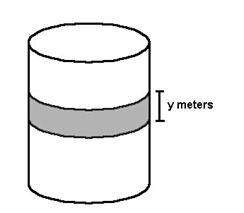
To find the surface area of the stripe, you need to know the circumference of the cylinder, but there is not data in the question that gives you the radius or diameter to let you find the circumference. Hence the answer should be that neither statement together is sufficient.