Tuck MBA essay tips for 2026-2027 cover three mandatory essays. Essays 1 and 2 test self-awareness, and Essay 3 tests an encouraging trait from the Smart, Accomplished, Aware, and Encouraging traits that Tuck uses to evaluate an applicant.
The guide starts with the art of writing a self-aware essay by exploring W.E.B. Du Bois's essay from The Souls of Black Folk (1903) collection.
Essay 1 tips include a Situation-Reflection-Insight structure for showing self-awareness. For Essay 2, Atul Jose shows how to weave a unique upbringing, community, or culture narrative into the learning. Essay 3 shows how the applicant supported a colleague who was initially difficult to work with.
TL;DR
- Tuck rewrote all three required prompts on July 1, 2026 and capped each at 2,000 characters, while the optional and reapplicant prompts kept the previous cycle's wording.
- Tuck scores applicants on four criteria, and the essays test two of them: Essays 1 and 2 measure whether you are aware, and Essay 3 measures whether you are encouraging.
- Essay 1 works as a chain from the origin of your goals to the growth you still need and then to Tuck. The Tuck section takes the largest share at 800 characters, and the remaining 1,200 split evenly between origin and growth. The Tuck section passes only if a reader cannot swap in another school's name.
- Essay 2 asks for one aspect of your identity in place of a life story. Applicants from finance and consulting, the two largest feeder industries in the Class of 2027, gain more from an upbringing, community or culture story than from a work example.
- Essay 3 needs one person and a real cost to helping them. Spend 900 of the 2,000 characters on your response, with 500 for the difficulty before it and 600 for what you learned, since Tuck weighs the learning as heavily as the story.
- Round 2 closes January 5, 2027, and a complete application with test scores and references submitted by 5:00 p.m. ET on December 1, 2026 guarantees an interview.
Contents
- What Tuck MBA Essay Tips Cover
- The 2026-2027 Essay Questions
- How Tuck Reads Your Essays
- How to capture the Four Selection Criteria in Tuck MBA Essays
- Essay 1: Your Goals, Your Growth, and Tuck
- Essay 2: One Aspect of Who You Are
- Essay 3: Supporting Another Person
- Optional Essay
- Reapplicant Essay
- Deadlines and the Interview Guarantee
- References
What Tuck MBA Essay Tips Cover
Tuck's admissions office publishes its own essay guidance every admissions cycle, and this essay tips is built on the 2026-2027 guidance written by Patricia Harrison, Director of Admissions, Evaluation and Yield[1]
Tuck replaced all three required essay prompts on July 1, 2026, set each essay at 2,000 characters, and left the optional and reapplicant essays unchanged from the previous cycle[2]
Each section below begins with what Harrison says the admissions committee looks for and then adds recommendation from Atul Jose – F1GMAT’s Founding Consultant & Essay Specialist for fitting that advice inside the character limit.
The 2026-2027 Essay Questions
Tuck sets each essay with a 2,000 character limit [2]
| Essay | 2026-2027 prompt | Criterion |
|---|---|---|
| Essay 1 (required) | Your professional goals are described elsewhere in your application. What led you to those goals and to your understanding of where you need to grow? Why is Tuck the right environment to support that growth and help you achieve your ambitions? | Aware |
| Essay 2 (required) | People are often shaped by experiences that are not fully reflected in their resume. Tell us about an important aspect of who you are that has shaped you as a person. How will your perspective enrich the Tuck community? | Aware |
| Essay 3 (required) | Describe a time when supporting another person was not easy or straightforward. What made it difficult, how did you respond, and what did you learn? | Encouraging |
| Optional | Please provide any additional insight or information that you have not addressed elsewhere (e.g., atypical choice of references, factors affecting academic performance, unexplained job gaps or changes). Complete this question only if you feel your candidacy is not fully represented by this application. | n/a |
| Reapplicants | How have you strengthened your candidacy since you last applied? Reflect on how you have grown personally and professionally and how your understanding of Tuck has developed. | n/a |
Harrison asks applicants to use judgment about detail inside the limit and warns that tricks such as joining words together to get past the count will count against an applicant
How Tuck Reads Your Essays
Tuck evaluates every applicant against four criteria: smart, accomplished, aware and encouraging [3]
Although admissions team often share that essay is just one part of the larger puzzle, the admissions team has openly shared certain criteria they evaluate with each application element.
For instance, transcripts and test scores show that you are smart, the resume shows that you are accomplished, the essays show that you are aware and encouraging and Letters of reference cover all four criteria[4]
| Tuck MBA Application Element | Selection Criteria |
|---|---|
| Transcripts and test scores | Smart |
| Resume | Accomplished |
| Essays | Aware and Encouraging |
| Letters of Reference | Smart, Accomplished, Aware and Encouraging |
For 2026-2027, Essays 1 and 2 map to the aware criterion and Essay 3 maps to encouraging
How to capture the Four Selection Criteria in Tuck MBA Essays
Smart, Curious, and Engaged
Although applicants with strong quant scores or academic accomplishment highlights those milestones in the resume, they can also share strong 'intellectual aptitude' by sharing a solution they developed. These solutions should not be described for their ingenuity alone. Share the genuine curiosity that led to the discovery of this solution. This is because Tuck's rigorous environment expects students to thrive when they are challenged. It is through challenging oneself and peers with better ideas or strategies that they will grow into a better professional.
Accomplished, Impactful, and Principled
It is one thing to highlight the accomplishments in the resume and another thing to share why you achieved such impressive goals. Give a taste of your planning, commitment, and thinking that helped you succeed in a professional role, in communities, or in a personal capacity. Evidence of acting with conviction and integrity, especially in challenging or ethical gray areas, is crucial, as these qualities enable bold decision-making and problem-solving while keeping all stakeholders in mind.
Aware, Ambitious, and Purposeful
Because self-awareness is one of the two most closely watched traits in Tuck MBA essays, you should have a clear understanding of what counts as self-aware essay writing.
In W.E.B. Du Bois's The Souls of Black Folk (1903)[9], there is a paragraph where Du Bois recalls the moment in a New England schoolhouse when he first understood that his classmates saw him as a different person.
"In a wee wooden schoolhouse, something put it into the boys' and girls' heads to buy gorgeous visiting-cards, ten cents a package and exchange. The exchange was merry, till one girl, a tall newcomer, refused my card, refused it peremptorily, with a glance. Then it dawned upon me with a certain suddenness that I was different from the others; or like, mayhap, in heart and life and longing, but shut out from their world by a vast veil. I had thereafter no desire to tear down that veil, to creep through; I held all beyond it in common contempt, and lived above it in a region of blue sky and great wandering shadows. That sky was bluest when I could beat my mates at examination-time, or beat them at a foot-race, or even beat their stringy heads. Alas, with the years all this fine contempt began to fade; for the words I longed for, and all their dazzling opportunities, were theirs, not mine."
Every self-aware statement follows the Situation, Reflection, and Insight format.
Situation: Friends discriminated against Du Bois for the color of his skin.
Reflection: "I had thereafter no desire to tear down that veil, to creep through; I held all beyond it in common contempt, and lived above it in a region of blue sky and great wandering shadows. That sky was bluest when I could beat my mates at examination-time, or beat them at a foot-race, or even beat their stringy heads. "
Du Bois is consoling himself through reflection on the many aspects where he was ahead of his peers. He shows his pride with the statement that "I had thereafter no desire to tear down that veil".
Insight: The true insight happened with true reflection instead of the instinctive reflection to console himself: "Alas, with the years all this fine contempt began to fade; for the words I longed for, and all their dazzling opportunities, were theirs, not mine"
Du Bois is accepting that although he beat his peers in academics and sports, the truth is that to succeed in society he had to break that veil and time-travel to a society where he is accepted as an equal.
There is no desperation in the tone, just an acceptance.
You can mimic and follow a similar strategy for your Tuck goals essay.
Case Study: Applicant, a Process Engineer in a Battery Cell Plant
Situation
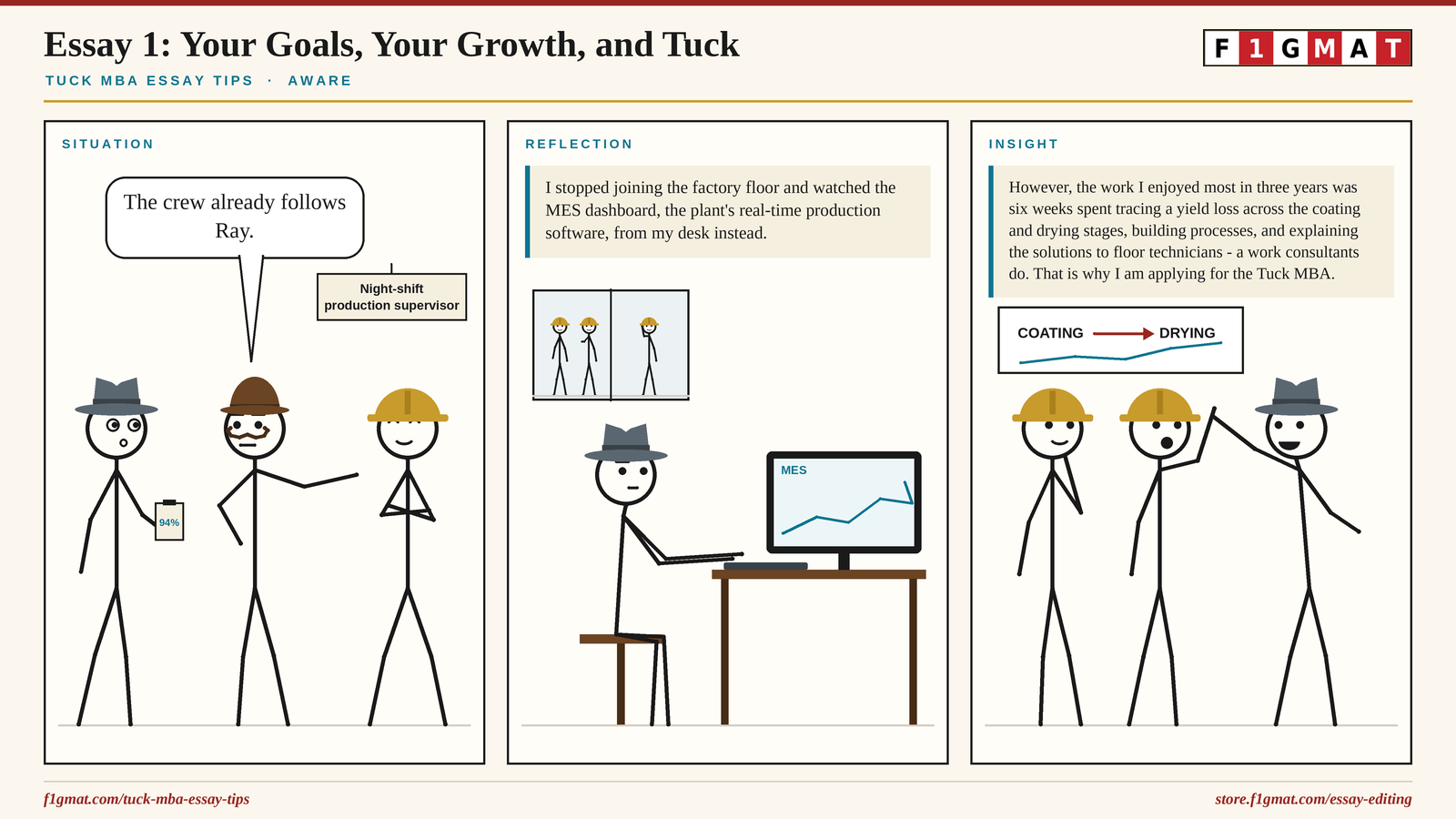
In my second year at the battery cell plant, the night-shift production supervisor role opened on the electrode line. I was the only process engineer on the line with a Six Sigma Black Belt, who achieved a first-pass yield from 88% to 94% - a record in our plant. The manager gave the role to Ray, a lead maintenance technician who had spent eighteen years keeping automotive lines running. When I asked why, he said, "The crew already follows Ray."
Reflection
I stopped joining the factory floor and watched the MES dashboard, the plant's real-time production software, from my desk instead.
This is like the instinctive and defensive reaction that Du Bois follows in his writing.
Should you include such reaction in an essay where the AdCom expects you to be stoic and mature.
Yes and No.
If you share a defensive action against persistent discrimination – the AdCom won’t consider it as immaturity.
It is a human reaction to protect their ego.
Insight
The satisfaction of the desk faded when two more supervisor roles opened, and both went to people from the floor. The culture prioritized factory floor operators over analysts at a desk. However, the work I enjoyed most in three years was six weeks spent tracing a yield loss across the coating and drying stages, building processes, and explaining the solutions to floor technicians - a work consultants do. That is why I am applying for the Tuck MBA.
This is the real insight.
By working in a culture where ground work is valued over analysis and top-level change, the applicant is realizing that he is a better fit for a career in consulting.
Encouraging, Collaborative, and Empathetic
Tuck values individuals who actively support and celebrate others, exhibit emotional intelligence, and work effectively in teams.
To illustrate how you can write Context for an 'encouraging' example, let u s look at W.E.B. Du Bois, "Of the Meaning of Progress," from The Souls of Black Folk (1903)
Background: As a Fisk University student, Du Bois spent two summers teaching in a log schoolhouse in rural Tennessee. When children stopped coming, he went to find them.
"I loved my school, and the fine faith the children had in the wisdom of their teacher was truly marvelous. We read and spelled together, wrote a little, picked flowers, sang, and listened to stories of the world beyond the hill. At times the school would dwindle away, and I would start out. I would visit Mun Eddings, who lived in two very dirty rooms, and ask why little Lugene, whose flaming face seemed ever ablaze with the dark-red hair uncombed, was absent all last week, or why I missed so often the inimitable rags of Mack and Ed. Then the father, who worked Colonel Wheeler's farm on shares, would tell me how the crops needed the boys; and the thin, slovenly mother, whose face was pretty when washed, assured me that Lugene must mind the baby. "But we'll start them again next week." When the Lawrences stopped, I knew that the doubts of the old folks about book-learning had conquered again, and so, toiling up the hill, and getting as far into the cabin as possible, I put Cicero "pro Archia Poeta" into the simplest English with local applications, and usually convinced them—for a week or so."
Every encouragement narrative should start with the context, action in the middle, and the result format with the result captured in a coherent line – to avoid repeating the resume narrative.
Context: "I loved my school, and the fine faith the children had in the wisdom of their teacher was truly marvelous. We read and spelled together, wrote a little, picked flowers, sang, and listened to stories of the world beyond the hill. At times the school would dwindle away, and I would start out."
Situation: "Then the father, who worked Colonel Wheeler's farm on shares, would tell me how the crops needed the boys; and the thin, slovenly mother, whose face was pretty when washed, assured me that Lugene must mind the baby."
The family needed helping hands.
Action: "I put Cicero 'pro Archia Poeta' into the simplest English with local applications, and usually convinced them—for a week or so"
Du Bois had to translate Cicero into a version the parents understood so that the education is valued over farming or other family chores.
Result: "and usually convinced them—for a week or so."
The result is the smallest part of the narrative.
Follow a similar strategy when you share such a change in behavior narrative.
Case Study: A Process Engineer Implementing a Training Program
Three technicians on my plant line stopped coming to the Tuesday training I ran for our new vision-inspection system. When sending reminder emails didn't help, I went to each of them on the floor during their shift. After a lot of hesitation on revealing the disinterest, two of them told me that the session clashed with the only fifteen minutes they had for shift handover. I moved the training close to their break at 3:00 pm and used the machine room instead of the conference room for the training. This change made the training close to the actual work and their attendance rose back to the 89% level we had achieved in the first month.
Context: Three technicians on my plant line stopped coming to the Tuesday training I ran for our new vision-inspection system
Situation: Two told me the session clashed with the only fifteen minutes they had for shift handover.
Action: I moved the training close to their break at 3:00 pm and used the machine room instead of the conference room for the training.
Result: Attendance rose back to the 89% level we had achieved in the first month.
Essay 1: Your Goals, Your Growth, and Tuck
Harrison asks applicants to use judgment about detail within the limit and warns that tricks such as joining words together to get past the count will count against an applicant[1].
Your professional goals are described elsewhere in your application. What led you to those goals and to your understanding of where you need to grow? Why is Tuck the right environment to support that growth and help you achieve your ambitions? (2000 characters)
Harrison places Essay 1 under the aware criterion and describes it as the essay about an applicant's vision for the future[1]. The goals themselves already appear in the short-answer section, so Essay 1 should explain why those goals exist [1]. Harrison characterizes the essay as a chain: the origin of the goals has to lead to the growth the applicant still needs, and that growth has to lead to Tuck.
Origin of Goal -> Growth the Applicant Needs -> Tuck -> Goal -> Growth Achieved
Part 1: Where your goals came from – Learned from Experience or Mimicked
| Part of the essay | The question Harrison asks | F1GMAT character budget |
|---|---|---|
| Where the goals came from | What experience, observation or moment made this path meaningful to you? | About 600 |
| Where you need to grow | Which gaps in experience, perspective or capability can a Tuck MBA close? | About 600 |
| Why Tuck | Which Tuck offerings close those specific gaps? | About 800 |
Harrison writes that the committee is left puzzled when a goal has no visible connection to the applicant's work, education, or community involvement, and that career changers in particular need to fill in that connection.
For those who are continuing in their chosen function, don't assume that the AdCom will continue to believe in your passion for the function. Share it explicitly - what particular aspects of their work interests them.
You don't need a chronological narrative reiterating the interest; just a moment is enough.
Atul Jose's recommendation: Build Part 1 around a single moment.
A goal from a real experience should be the priority over a goal you acquired by mimicking a thinker or a peer or an influencer in your industry.
Applicants often use a thought leader to mimic a gap and use generic motivation in their goals essay. There is no personalization or urgency in the narrative.
Mimicked version with Generic Goal
Andrew Ng has argued that talent is the scarcest resource in AI, because every model has to be customized to a specific business context. Hospitals have invested heavily in predictive tools, yet adoption on the wards lags, because workflows and staffing differ from one hospital to the next. The consulting function bridges the gap. I want to continue in consulting and specialize in AI deployment for healthcare systems, where my consulting solution decides whether an investment pays off.
The same Andrew Ng quote will be impactful if the applicant shared a personal consulting experience.
Stronger version Based on Real Experience
Last year, my team extended a readmission-risk model from a health system's flagship hospital to a community hospital it had just acquired. The model had performed well at the flagship system, but at the new site its accuracy fell by a third within a month.
I found the gap to emerge from a data release process the community hospital's system had adopted, where overnight results were used as data in a single 6 a.m. batch. The model was scoring morning discharges on the previous day's reports. I found that running the model at 7 am - the cutoff we designed was the right adjustment. The accuracy recovered within two weeks.
The gap educated me on the importance of training the digital team on the specific use cases of operating the model before taking it live for a new hospital system.
Andrew Ng has argued that talent is AI's scarcest resource because every model has to be fitted to its business context. I have implemented such one-hour adjustments while delivering AI-driven solutions based on hospital types, cities, and regulations. I want to continue integrating complex AI systems to make health systems efficient through consulting.
Tuck MBA will build the finance, operations, and strategy perspective to align stakeholders, train them with top-down communication, and create controls that detect and flag errors before AI systems create systemic weaknesses in our healthcare industry.
Part 2: Where you need to grow – The Specificity Test
Tuck used to ask applicants why they wanted an MBA.
Harrison says the committee still wants that answer, narrated around what the applicant needs from the degree in place of what the degree offers.
She asks for honest self-assessment over a reverse advertisement of an MBA.
Atul Jose’s recommendation: Choose a genuine gap that can only be written by you and is closely tied to a specific milestone within your post-MBA goal.
If a reader could predict your gap from your job title, it will failed the specificity test.
Weak version (Predictable)
To lead AI transformations for healthcare systems, I need to strengthen my strategic thinking and executive presence. My technical background has taught me to analyze complex cross-functional problems. A Tuck MBA will give me the general management toolkit to lead engagements and advise senior leaders.
Strong version (With Authentic Skill Gaps)
My team deployed a readmission-risk model at a community hospital that a health system had just acquired. Within a month, the model's accuracy fell by a third. The hospital's lab system released overnight results in one batch at 6 a.m. Instead of scoring the latest discharge data, the model scored morning discharges on the previous day's lab data. We ran the scoring run from 7 a.m instead of 6 a.m. When I wrote a memo to the client explaining the technical cause and the fix for the inaccuracy, the CIO treated it as a scheduling change and asked why it needed his budget. When I raised the same issue with the CFO, he treated it as an unplanned interface request and deferred it to the next planning cycle.
Without meaningfully receiving any buy-in from the hospital, I shared the issue with our engagement partner. She wrote a memo, which covered the hospital's financial exposure under Medicare's Hospital Readmissions Reduction Program, which can reduce a hospital's base Medicare payments by up to 3%, and estimated the cost of each week of delay. She moved my technical explanation to an appendix.
Within two days, the CFO approved the change, five weeks after I first found the problem.
The delay in receiving buy-in was caused by how I presented the case. I explained a technical problem to executives who made decisions on financial terms. Since then, I have read the hospital's cost reports and completed an online course in health care accounting. My post-MBA goal is to lead system-wide AI deployments as an engagement manager. That role requires me to understand a health system's margins and payer mix well enough to present technical problems through a financial lens.
Gap:I explained a technical problem to executives who made decisions on financial terms
Why Tuck: My post-MBA goal is to lead system-wide AI deployments as an engagement manager. That role requires me to understand a health system's margins and payer mix well enough to present technical problems through a financial lens.
Part 3: Why Tuck – Why Not HSW or Other M7
Harrison's test for this part is whether the reader could replace the word Tuck with another school. She lists the curriculum, experiential learning, individualized career guidance, and the community and alumni network as fair coverage.
Instead of quoting 2-3 current students or alumni, she asks applicants to report what those conversations taught them [1].
Atul Jose’s recommendation: Combine each gap from Part 2 with one Tuck experience. More than 2 experiences is a tough stretch for a 300 word or a 2000 character essay.
General version (fails the swap test):
Tuck's close-knit community and collaborative culture make it the ideal place for me to grow. Conversations with current students - Name 1 (year) and Name 2 (year)- confirmed that Tuckies support one another through every setback and milestone. The Center for Health Care and the First-Year Project will give me the health care expertise and hands-on experience I need to reach my goals.
Strong version
Tuck's Structure, Organization and Economics of the Health Care Industry course examines how health care is financed from the perspectives of providers, payers, suppliers, and consumers. That is the view I lacked when the CFO deferred actions around my memo. The second gap is practice. Tuck's First-Year Project now requires every team to research, build, and test an AI-driven solution for a real client over nine weeks, with a faculty advisor working alongside the team. A second-year in the Health Care Club told me her team's hardest week was when the client asked to estimate the cost of running the solution. That is the conversation and practice I need before I can lead a deployment of my own.
Essay 2: One Aspect of Who You Are
People are often shaped by experiences that are not fully reflected in their resume. Tell us about an important aspect of who you are that has shaped you as a person. How will your perspective enrich the Tuck community? (2000 characters)
Harrison places Essay 2 under the aware criterion as well, with the focus on self-knowledge in place of career direction[1]. The resume tells the committee what an applicant has done; Essay 2 tells the committee who the applicant is[1].
Harrison reports that applicants from industries heavily represented in the pool ask her how to stand out, and she points them to this essay.
Choosing the aspect
Harrison says the prompt has no right answer and no right category of answer. Her examples include upbringing, a community, culture, relationships, challenges overcome, personal values and a defining moment, and she allows professional experience for applicants whose perspective was formed at work.
Because space is tight, she asks applicants to write about one significant aspect of their identity in place of a life story.
Atul Jose’s recommendation
Treat the overrepresented-industry problem as a numbers problem.
Financial services and consulting each supplied 19% of the Class of 2027's most recent employers[5]. Non-Profit and Government is also a strong 14%. Technology at 11% and healthcare at 9% completes the class.
This creates an interesting problem.
Even if you are from industry outside Finance and Consulting, you have to find a unique upbringing, community or culture narrative that reveals your value.
It is too risky to highlight a professional example.
How you will enrich Tuck
Harrison says the committee cares most about the person who will show up and how that person will add to classmates' experience, and that contribution extends beyond formal leadership roles and club membership[1]. Applicants may mention parts of Tuck where they plan to take part, but the center of the essay is what classmates will learn from them.
Atul Jose’s Advice:
Budget about 1,200 characters to ‘What Makes you Unique’ and keep the essay around ‘one’ value you acquired through your upbringing or culture, and how it shaped you. Allocate 800 characters for the contribution.
Write the contribution as a scene in a study group or a class discussion.
Don’t just list student clubs.
Sample Tuck MBA One Aspect of Who You Are Essay – Grandfather’s Influence in Conflict Resolution
Until I was twelve, I spent every summer at my grandfather's feed store in a farm town outside Ames, Iowa. He was a township trustee, a role that involved resolving disputes between neighbors.
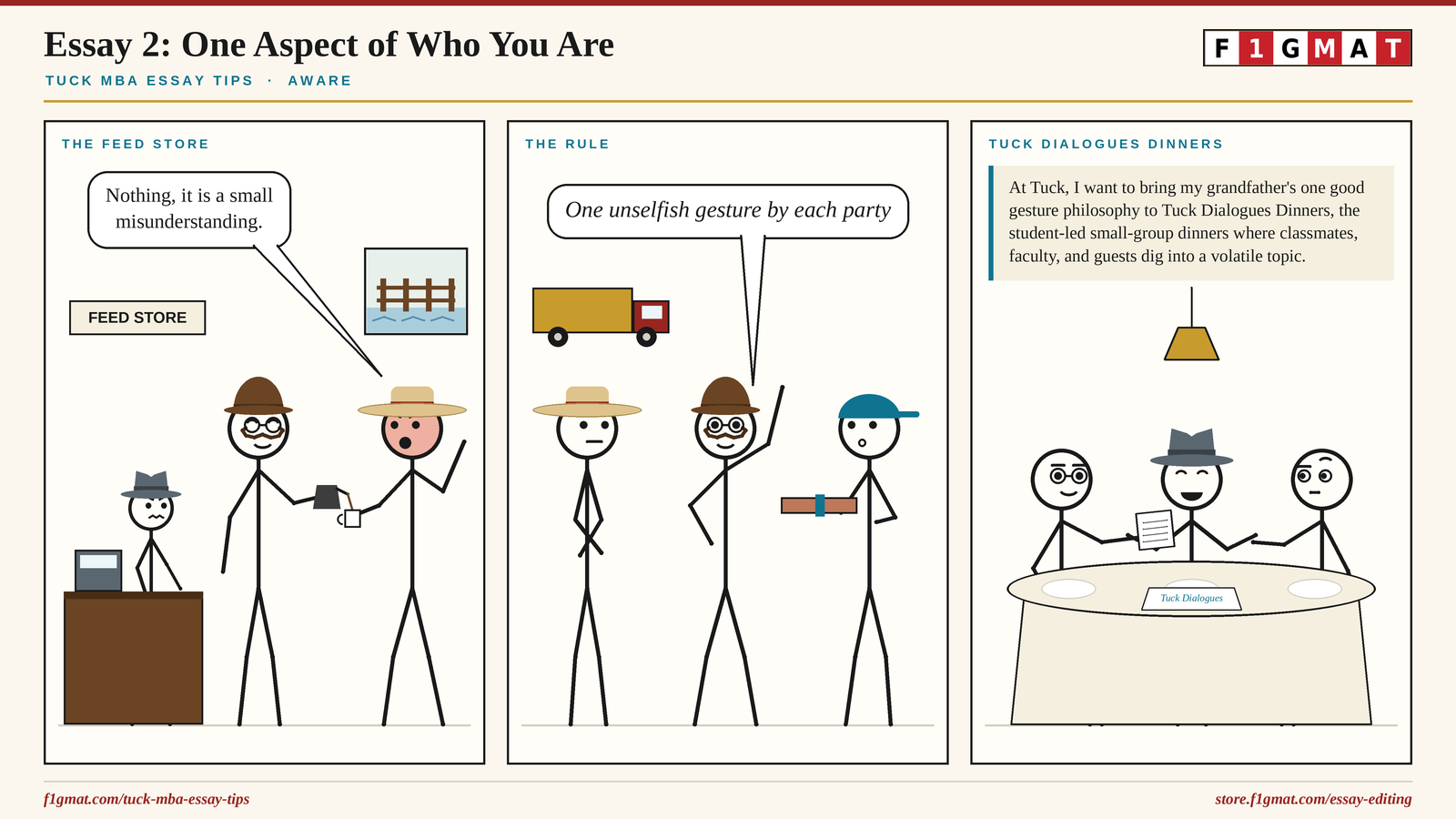
One August, a farmer came in red-faced and said, "Nothing, it is a small misunderstanding," pointing at the family across the road. My grandfather refilled his mug and asked about his daughter's wedding. I stood behind the register, impatient to intervene and solve the conflict.
Twenty minutes later, he opened up, "The family across the road had put up a new fence six feet onto his side of the property line. In doing so, the post holes cracked the drainage tile, and now his fields are flooded." He had not said any of this at first because the neighbor was his wife's cousin.
My grandfather had one rule: "One unselfish gesture by each party" before any mediation. The farmer lent his neighbor his grain truck for the harvest, and the neighbor paid to repair the broken tile.
The fence dispute was resolved in a week, whereas our last dispute in the neighborhood took a year.
When we moved to Chicago, in my senior capstone, our four-person team built an inventory-tracking tool for a food bank on the South Side. By midterm, the team had split. Priya was writing most of the code late at night and resented Devon, who kept missing our evening meetings. I asked Devon the reason he was missing the deadlines. After a lot of probing, he shared that he worked night shifts at a UPS sorting hub to cover his tuition. Before our next meeting, I asked Priya and Devon to do one unselfish thing for each other. Priya recorded a twenty-minute walkthrough of her code so Devon could work on it after his shift.
Devon took over the Saturday visits to the food bank, which Priya had been dreading. We delivered the tool on schedule, and the food bank used it to track donations through the winter.
I kept the philosophy for consulting too. At a 300-bed hospital in Ohio, the director of pharmacy told our team that medication losses were "a data issue." The reports came back clean, and the losses continued. By then, she was defensive because our work implied her records were wrong.
On our third visit, I slowed down. Before I asked her anything, I told her that the reports she had given us were accurate and that our team had been wrong to start there. The gesture changed her body language. She shared her own investigation which showed that at night, two technicians had been skipping the count on the two farthest wards because there was no time for them to change and catch the Bus. Every skipped count turned an ordinary discrepancy into an unexplained loss on her report. She didn't want to reveal the names because the technicians came from underprivileged background.
Fixing the problem meant hiring a third night technician. The director was in a poor position to ask. Our team had just spent three weeks treating her records as the problem, and a request for more staff would have sounded like an excuse for her department's losses. So I wrote the request myself, with the count schedule and the cost of each skipped count, even though it was outside our project's scope. Our engagement partner then took it to the CFO as the consulting team's recommendation. If the CFO said no, the refusal would fall on us instead of her. The CFO approved the hire in two weeks. With a third technician, every ward was counted every night, and unexplained losses on those wards fell by more than half the next quarter.
At Tuck, I want to bring my grandfather's one good gesture philosophy to Tuck Dialogues Dinners, the student-led small-group dinners where classmates, faculty, and guests dig into a volatile topic. As the tables are built for honest disagreement, I would request each guest to do one small thing for the person at the table, such as bringing a news source from the other person's side of the argument. I expect classmates to test the rule, and if it works in finding common ground, we will adopt it as a new communication framework for consulting engagements.
Instead of discussing about a virtue, the applicant is highlighting a personal style of managing conflict into Tuck’s Dialogues Dinners
Essay 3: Supporting Another Person
Describe a time when supporting another person was not easy or straightforward. What made it difficult, how did you respond, and what did you learn? (2000 characters)
Essay 3 maps directly to the encouraging criterion.
Harrison writes that Tuck students help one another when it is inconvenient or of no direct benefit to them. Essay 3 asks how an applicant shows up for someone when support demands empathy, effort, judgment, or personal investment. Her summary of the prompt is short: "At its heart, this is a relationship essay."
One story, one person
Harrison asks for one specific, discrete story focused on one other person, or at most a very small group. The story can be personal or professional. Her examples include helping a struggling teammate, handling conflict, advocating for someone, supporting a friend through a hard period, repairing a misunderstanding, and giving difficult feedback.
What to leave out
The words "not easy or straightforward" are a hint Harrison is sharing to avoid applicants from sharing typical mentorship examples or coaching that are part of most teams. There should be some cost to helping this person - either in reputational harm or risk to the success of the project.
Also avoid stories that involve large group as the essay can turn into a leadership essay. At its core, the essay is a measure of how you maintain relationships when it is not easy to do so.
A modest outcome is acceptable.
The committee reads Essay 3 for empathy and for the applicant's investment in another person's success or well-being. Here scale of the IMPACT is not important.
What you learned
Harrison gives the learning the same weight as the story[1]. The final paragraph should show how the experience changed the applicant's approach to conflict, feedback, mentorship, advocacy, or empathy.
Atul Jose’s recommendation
Budget about 500 characters for the situation and what made it hard, about 900 for the response, and about 600 for the learning.
A story in which helping was easy and the task was hard is a teamwork story.
Sample Tuck MBA Supporting Another Person Essay – Working with A Difficult Colleague
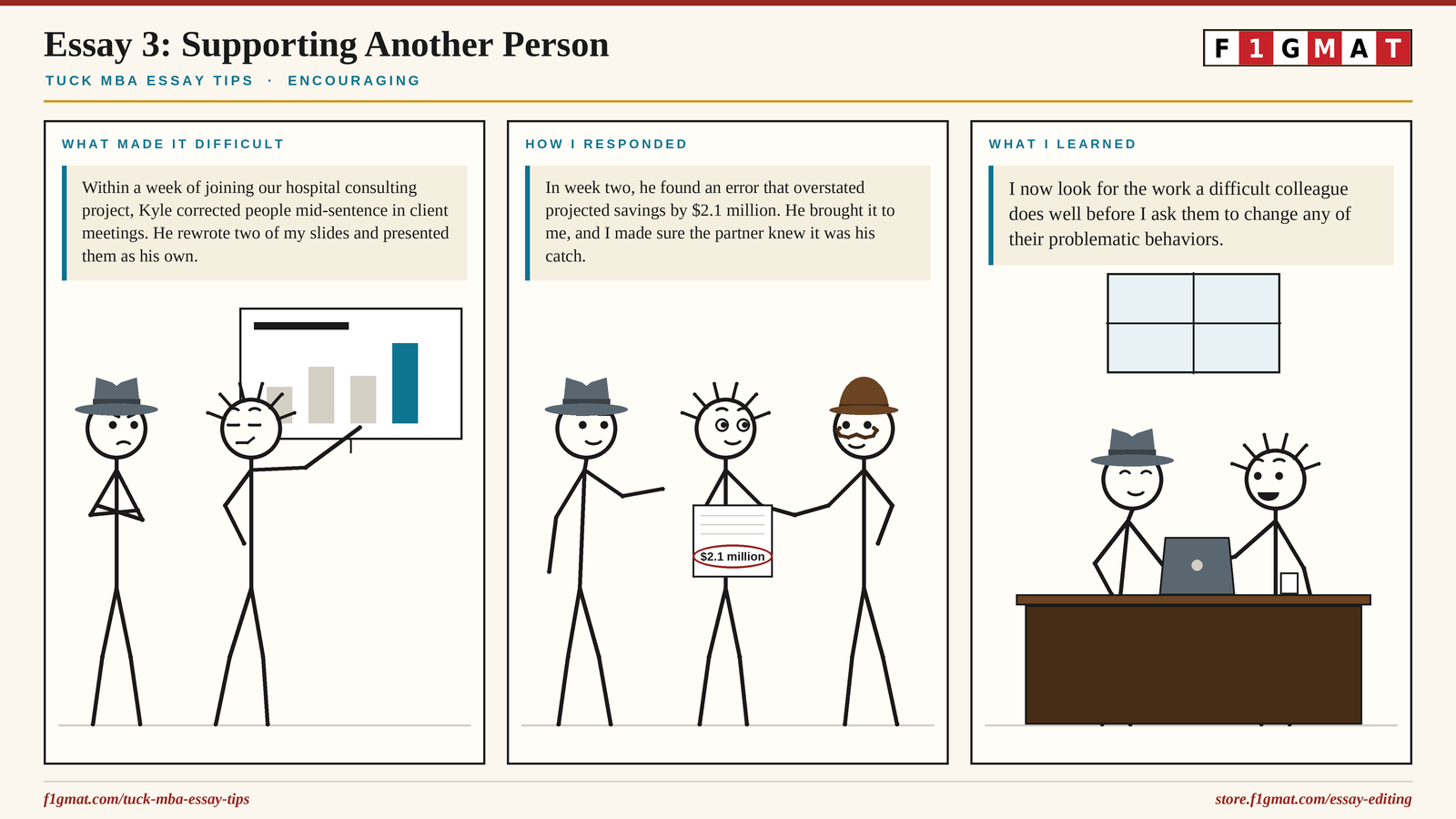
Within a week of joining our hospital consulting project, Kyle corrected people mid-sentence in client meetings. He rewrote two of my slides and presented them as his own.
When our manager shared that she had received complaints about Kyle's lack of team spirit and that she planned to move him out of the team, I felt relieved.
On second evaluation, I hesitated to support our manager's decision. Kyle had fixed an error in my cost figures, and that correction required deep expertise.
While we got acquainted with each other's process, he shared that his father left when he was eight. The moving across relative's homes until college had led to a deep distrust of people. Anyone who reviewed his work would start a fight with him. He wanted to be right first, but as we worked on two more presentations, I could see Kyle slowly mellowing down and accepting my suggestions without a scene.
I requested that the manager keep him for three weeks under my supervision, and gave him a task that checked every formula in the savings model before it was presented to the client.
In week two, he found an error that overstated projected savings by $2.1 million. He brought it to me, and I made sure the partner knew it was his catch.
He still interrupted people, although less often.
Six months later, Kyle moved to a data role at a smaller firm. He was a better fit in that startup culture and sent me a model he built there.
I appreciated and encouraged his unique way of thinking.
That experience has taught me that I do not need to like someone based on first impression.
What broke the barriers with Kyle was going to a mindspace where his strength was appreciated and validated by the team. Once he felt seen, the conflicts died down.
I now look for the work a difficult colleague does well before I ask them to change any of their problematic behaviors.
Optional Essay
Please provide any additional insight or information that you have not addressed elsewhere (e.g., atypical choice of references, factors affecting academic performance, unexplained job gaps or changes). Complete this question only if you feel your candidacy is not fully represented by this application. (2000 characters)
Addressing Unexplained Job Gaps or Career Transitions
The AdCom will infer that you lack the professional maturity to stick to a job if the number of job transitions is anywhere above 3-5 for a 3-5 years of experience (1 year 1 job). Frequent job transitions or extended career gaps might raise concerns about career stability, direction, or adaptability.
The applicant must address these transitions with proper explanation around layoffs and the logic behind each transition.
When explaining the job switch or career gaps, share how you have been working towards the MBA goals. Include social skill acquisition - volunteering and technical skill acquisiton (certification) in the optional essay.
Explaining Atypical Recommender Choices
MBA programs expects current supervisors to write the letter. This is the norm in companies with strong MBA recruitment pipeline.
If you choose someone outside of this standard expectation, the admissions team may wonder why your direct manager isn’t providing the recommendation.
One common reason is that there could be negative repurcussion for revealing such plans in a highly stressful corporate environment or in a bad economy where the risk of job loss is already high.
Share the constraint.
Contextualizing Academic Performance
Some universities has strict grading upper limit. Even if the AdCom might know this divergence, share the performance relative to the top performers in the class (top 1 percentile etc).
Admissions committees will review your academic transcripts and test scores to assess your ability to handle the rigor of an MBA program.
If you have low grades in key courses, a weak GMAT/GRE score, or inconsistencies in your academic performance, they might question your preparedness for the program.
Share the foundational MBA courses you took or the grades from Statistics/Calculus or alternative transcript to prove otherwise.
Discussing Personal Circumstances That Impacted Your Journey
Many of the hardship narratives I have read involve self-funding education. This means dedicating time away from required quant courses to a part-time job, caring for a family business, or caring for an ailing parent/grandparent. The GPA falling below the class median is the obvious impact.
Don't make any excuses. Cite the situation.
Also, share what you have done to acquire the missing quant exposure.
Many applicants stop at the challenging circumstances without showing any self-awareness that, to overcome the rigor of the MBA program, one must be strong in foundational quant courses - including Statistics and Calculus.
Reapplicant Essay
How have you strengthened your candidacy since you last applied? Reflect on how you have grown personally and professionally and how your understanding of Tuck has developed. (2000 characters)
The 2026-2027 prompt asks reapplicants to explain how their understanding of Tuck has developed, in addition to their personal and professional growth[2].
Reapplicants need to demonstrate growth, self-awareness, and a clear trajectory of improvement. Tuck’s admissions team wants to see evidence of how you’ve strengthened your skills, refined your career goals, and deepened your impact since your last application.
Demonstrating Professional Growth
Share any change in scope of your responsiblities even if there were no promotions. It happens more often especially now when the cost pressure is high. Companies expand the responsibilities without a change in job titles.
Strengthening Academic and Technical Skills
Share all the relevant certification you have taken to address any preparedness questions the AdCom might have. Prioritize Finance related certifications if you are coming from Humanities or Liberal Arts.
Showcasing Personal Growth and Leadership in the Community
Tuck highly values candidates who engage with their communities and demonstrate leadership beyond their professional roles.
Share recent volunteering experiences and your role in changing a neighbourhood or funding/increasing reach of a non-profit.
Clarifying a More Focused Post-MBA Goal
A re-applicant essay should also show that you have refined and clarified your career goals. The admissions team wants to see:
- If you have gained deeper industry insights that reaffirm your path.
- How your professional trajectory has evolved and aligned more closely with an MBA?
- Why Tuck is the right place to help you achieve your newly refined goals.
Showing How Your Understanding of Tuck Has Developed
The prompt asks reapplicants to show that their picture of Tuck has changed since the last application[2]. F1GMAT recommendation: describe one belief about Tuck that a class visit, an event or a conversation corrected or deepened, and explain how it changed the way you plan to use the two years. Harrison's Essay 1 advice applies here too: report what you learned from Tuck students and alumni, and leave out the list of people you contacted.
Deadlines and the Interview Guarantee
Tuck offers three rounds for 2026-2027[2].
Applicants who submit a complete application, including test scores and Letters of Reference, by 5:00 p.m. ET on the guaranteed-interview date receive an interview invitation[8].
All other interviews are by invitation, and Tuck values guaranteed and invitational interviews equally.
| Round | Application deadline | Guaranteed-interview deadline |
|---|---|---|
| Round 1 | September 24, 2026 | September 1, 2026 |
| Round 2 | January 5, 2027 | December 1, 2026 |
| Round 3 | March 24, 2027 | No guarantee |
References
- Patricia Harrison, "Tuck Admissions Insights: 2026-2027 Application Essays," Tuck 360 blog, July 1, 2026 ↩ ↩ ↩ ↩ ↩
- Tuck Communications, "Tuck Looks Ahead to the Class of 2029, Launches 2026-2027 MBA Application," July 1, 2026 ↩ ↩ ↩ ↩ ↩
- Tuck School of Business, "Admissions Criteria" ↩
- Tuck School of Business, "Applying to Tuck" ↩
- Tuck School of Business, "Class Profile," MBA Class of 2027 - F1GMAT's Top 15 MBA Class profile Analysis ↩
- Tuck School of Business, "MBA Employment Statistics," Class of 2025 (data as of October 2025)
- Tuck Communications, "Tuck MBA Internship Diaries: Class of 2025," Tuck 360 blog, December 10, 2024
- Tuck School of Business, "Interview with Tuck" ↩
- The Souls of Black Folk by W.E.B. Du Bois; 1903 ↩

