 We had interviewed many MBA Admissions officers and Marketing Managers. It is rare that you encounter a school's representative that bleeds passion and belief in their program's potential to reach #1 in Global MBA Rankings.
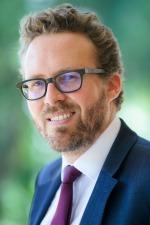
In recent rankings, IESE has been challenging the dominance of INSEAD and London Business School to take over Europe's #1 spot. In such an exciting time for the Spanish Giant, we are pleased to publish the first part of the interview with Pascal Michels - the Director of MBA Admissions at IESE Business School
What is the biggest misconception about IESE Full-time MBA program?
I would say that with a predominance of one year programs in the European market there is an assumption that two-year programs are more relaxed. This is certainly far from true regarding IESE. Academically, our full-time MBA is extremely rigorous, especially during the first year. This is done on purpose because we believe that people get the best out of the learning experience only if they are stretched to their limits. I have no doubt that the first year of our program is at least as intense as the most intense one year programs out there.
Another feature of our full-time MBA which people may not be fully aware of is that we have an extremely strong recruiter portfolio.
IESE is a target school for top banks, consultancies, and industry heavy-hitters. At the same time, the school is very entrepreneurial. There are a lot of things we do in that space, such as our Summer Entrepreneurship Experience, our IESE-students/alumni focused VC fund (FINAVES) and the entrepreneurship classes themselves.
One aspect I would particularly highlight is that IESE is, with Stanford, one of the leading schools in Entrepreneurship through Acquisition (Search Funds), an area in which I expect to attract a lot of interest in the coming years.
Why the 19-month duration of the full-time program instead of 12-month or 24-month?
Our MBA was created with the help of Harvard Business School and emulated HBS’ five-term, case-study based approach. There is an HBS-IESE Committee that has been meeting since 1963 to guide IESE’s growth. Another reason for our duration is the intensity of the first year.
The second year offers a balanced experience, with its choice from more than 100 electives, the possibility of going on exchange with top business schools around the world, the overseas modules available in New York, Sao Paolo, Shanghai and Nairobi, an extremely vibrant student club ecosystem and many other elements of customization.
The first year is about acquiring the essential know-how of how a business or any organization is run.
The summer – whether that is in the shape of an internship or through entrepreneurship – and terms 4 and 5 are all about exploring and experimenting.
The IESE campus in Barcelona is a beautiful and exciting place, vibrant with diverse people and ideas. It is really in the second year that students have the time to choose for themselves and explore the wide range of amazing possibilities.
How is the first year curriculum designed?
The first year is divided into three terms of 3 months each. During these 9 months, our students will go through the core MBA curriculum. This is academically very rigorous and demanding experience, irrespective of students’ prior backgrounds or academics.
Students start their day with meeting their teams of 8 or 9 students. These teams are designed by us before the beginning of the class.
Nobody can choose their team, nor is it possible to change or drop out. Team meetings are taken very seriously and build the backbone of the student experience. Your team becomes your anchor, your support system.
The team discusses the three cases for the day, each member making their contribution based on their understanding of the case. You would be surprised at how diverse viewpoints can emerge from the same case material.
Then students go to class in their sections. All members of a team pertain to the same section, and there are 5 sections of roughly 70 students.
The classroom experience at IESE is very curated. Every student gets assigned a specific spot during each of the three terms. Professors have seating map with them for each class and very quickly not only know who sits where but also what their background is. This leads to cold-calling, often when students least expect it.
The case discussion is generally very intense: 75 minutes just fly by. And there are 3 of these every day. After classes, students divide their time between Spanish classes, career-related work and, obviously, preparing the 3 cases that will be discussed the following day.
From a content standpoint, the classes are organized so as to build on each other over the three terms, thus enabling perfect newcomers to work their way through to the most technical aspects of a field.
If we take the field of Finance, the first term will focus on Financial Accounting and Capital Markets, the second will cover Managerial Accounting and Operational Finance, while the third term will bring it all together with Corporate Finance.
For those students who want to dig deeper, there is a wide range of electives (100+) to choose in the second year.
What are the various summer experiences that students can choose?
IESE’s two-year curriculum contains a mandatory summer internship between the first and second years. Our career services team is strong and maintain excellent recurrent relationships with top recruiters in all sectors.
What deserves highlighting at this point is that IESE has a robust footprint in strategy consulting, tech and finance, and puts impressive resources at the disposal of candidates to prepare interviews and secure jobs in these sectors. At the same time, we are not known to be either a “consulting,” “finance” or “tech school,” which is reflected in candidates’ aspirations. There are a lot of exciting things happening in the consumer, retail, pharma and heavy industry spaces as well.
A few years ago, responding to student demand, we introduced the Summer Entrepreneurship Experience (SEE), which roughly 10% of students choose to participate in every year. Access to the SEE is managed through an application process. Students form groups of 2 or 3 around a business idea which at the point of the application should already be well fleshed out. If admitted to the SEE they will then receive mentorship by professors, investors, and entrepreneurs from the IESE ecosystem over the summer.
How effective are summer corporate internships in getting full-time job offers?
This varies hugely by sectors. In investment banking, the sector I have been looking after during my time in Career Services, securing a summer internship is the only way to get a full-time job: banks will make these offers at the end of the summer and will not return on campus to interview second-year students.
Consulting operates with a similar model but does come back in October to interview second-year students for full-time roles. In other industries there is a mix of everything: some companies proceed like consulting firms while others focus either on summer internships only (e.g., small structures that do not have the capacity to hire MBAs full-time) or only on full-time hiring. In any case, the summer internship is ALWAYS a great first step in the direction a student wants to take full-time.
Even if the company of your dreams does not offer a summer internship at the MBA level, doing a summer internship in that sector, of completing your CV through an internship exploring a new function is a great way of preparing your full-time application.
2nd Year at IESE has an emphasis on real-time learning. Can MBA candidates choose specializations?
In line with our ambition to develop General Managers who will have a positive impact on the society, we do not offer specializations as such. However, there is a wide range (100+) of electives students can choose from, which effectively allows students to customize their experience in a very specialized way if they so choose.
The only distinctive degree we deliver is that of “bilingual MBA” to those students who complete all 12 levels of our Business Spanish Program. Actually, a number of applicants choose us because of how robust this program is and how valuable Spanish as a language is in the business world today. We have success stories every year of students hailing from remote cultures and graduating with professional fluency.
Reference
IESE Overview
IESE Search Funds for Entrepreneurship
IESE Bilingual Experience
About Pascal MichelsPascal Michels heads the MBA Admissions at IESE Business School. Before taking on the role as the Gatekeeper for the 350+ Full-time MBA class, Pascal was with the career services team managing the relationships with key stakeholders in the Financial Services sector and coached Full-time MBA students pursuing a career in the industry.