F1GMAT interviews Mr Kannan – Head of Admissions & Financial Aid for Indian School of Business and discusses about the rising popularity of ISB among Indian and Global MBA candidates.
F1GMAT: What is the biggest misconception about ISB PGP programme?
Kannan: One of the biggest misconception is that a one year program is not enough to cover the ground covered by a two year program. Our one year program is benchmarked with the best in class in terms of class room contact hours. For instance a Wharton MBA typically has 680 class room contact hours. Our one year program also has between 680 to 720 hours with 680 being the minimum a student will go through. The upper limit is dependent on the kind of electives a student takes and we do have a reasonable flexibility on this.
F1GMAT: The first thing that an MBA candidate looks in a Business School is its accreditations. Is ISB PGP programme accredited? What is the difference between a PGP and an MBA programme?
Kannan:At the moment our programme is not accredited however we have sought AACSB accreditation and we expect to receive that in about a year’s time. We have already made substantial progress towards receiving the AACSB accreditation. There is no difference in the course content between the PGP we offer and an MBA. The only reason for calling it an PGP is the legal framework in India which only permits Universities to grant Degrees like the MBA. We are not a University and hence cannot award degrees
F1GMAT: ISB is popular among Indian students. What are some of the opportunities for International students after they graduate from ISB?
Kannan: A large number of international companies are either entering India through subsidiaries or are expanding their existing presence in the country. This gives an international student opportunities of growth with these organization and the added opportunity to get back to their home country after successful stints in the emerging market like India. The international student also has opportunities for careers in Geographies like the APAC region, Middle east and other developed regions of the world. We have nearly 60 organisations from these regions that regularly recruit from ISB and we have seen significant growth in the number of companies from these regions that recruit from ISB
F1GMAT: Has the state of the economy affected ISB graduate's job prospects?
Kannan:While world wide the economies have shown a decline the Indian economy has continued to grow at upwards of 6% annually even during the period 2008-2009. There was an impact on the ISB graduating class as a result of the global slow down but the impact was by way of a lower average salary as compared to the class of 2008. We have since seen an improvement for the class that graduated in the year 2010 with number of jobs going up nearly 30% with an average salary going up by nearly 10% as compared to the class of 2009. The situation continues to be buoyant and we anticipate further increases in average salaries this year as well.
F1GMAT: Every school promotes its MBA programme with some common marketable features like Accreditations, ROI, Job prospects and Unique learning methodologies. What other factors make ISB PGP programme unique?
Kannan:ROI and Job prospects at the ISB are comparable with the best in the world but over and above that what makes us unique are the following:
- Our unique faculty model where we get the best faculty from across the globe to teach at the ISB
- Our team learning. Teams are mandated in all courses and the teams are pre-decided by ISB and not left to the choice of the student. This results in a very divers sets of teams and enhances the learning experience
- Our entrepreneurship courses. One of the most popular course on the subject runs a competition each year where each group in the course is given Rs.500 to start with and they are expected to run a short business for two weeks with that. The highest earning group is the winner. The competition is called “Make as much as you can” and is a popular contest on campus.
- Our school also incubates five to seven high potential business ventures each year
F1GMAT: Do you think a candidate participating in a one year ISB PGP programme is at a disadvantage compared to a candidate who has completed a 2-year MBA programme?
Kannan: From a course content stand point there is no disadvantage of a one year programme as compared to any two year programme. In fact the one year programme is ideally suited for working professionals as there is a significantly lower opportunity cost associated with a one year programme as compared with a two year programme. With all the benefits of a two year programme with the advantage of a lower overall cost (if you factor in the opportunity cost) a one year programme at ISB is definitely recommended over a two year programme
F1GMAT: According to your observation, which industries do ISB graduates get into
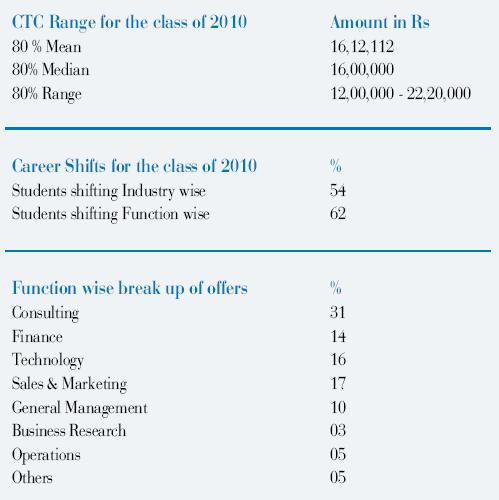
Kannan: ISB graduate get into a very wide variety of industries and roles. The following shows the industry and role distribution of the class of 2010 the most recent class.