Critical reasoning, like its name, is a critical component of the GMAT exam. It is part of the Verbal Section, with 41 questions that need to be completed in 75 minutes. This section also has questions on Sentence Correction and Reading Comprehension. The Critical Reasoning component is comprised of 14 to 16 questions. They are designed to test reasoning abilities, and how well the test taker can judge the flaws, assumptions and conclusions in a given statement. What makes these questions important for GMAT participants is that it is an immense scoring opportunity. A well-prepared candidate can answer the questions quickly, and dedicate more time to Reading Comprehension questions, or the tricky Sentence Correction section.
In GMAT Critical Reasoning, a statement is followed by a Question, which can be broadly categorized under:
1) Finding assumption in a statement
2) Finding argument that strengthens or weakens the statement
3) Drawing an inference or conclusion
4) Picking the flaw in an argument
5) Identifying the argument structure
6) Choosing the right conclusion.
The answer should be picked from five choices. The answers are designed to confuse the test taker. Two answers in particular will be similar and structured in such a way that the test will take up lot of the candidate's time.
The trick is to thoroughly analyze the statement while reading it. Test takers must try to figure out the logical flaws, strengths and assumptions in the argument and reach a conclusion as to whether the statement makes sense or not. Even if a firm decision cannot be reached, at list two answers should be shortlisted for Process of Elimination.
There are 4 common logical fallacies made in GMAT Critical Reasoning questions.
1) Generalization
It is very easy to generalize based on incomplete assumptions, and insufficient evidence.
Example: Indian Judiciary is known for delaying verdicts, therefore the recent fast track court appointed for Delhi Rape Case can also expect the same delay.
Generalizing the response of Indian Judiciary, and extending it to all cases is a logical fallacy and if you read the answer choices carefully, it is easy to eliminate such choices.
2) Ad Hominem
Ad Hominem in Latin means 'to the man.' It refers to an argument made against a person, rather than dealing with his argument. Students must be careful in dealing with statements that attack the source and not the message.
Example: The doctor's article on the perils of smoking, including cancer, cannot be taken seriously, as he is known to be a heavy smoker.
Just because the Doctor smokes, it does not mean that he is not eligible to speak against smoking.
3) Inconsistencies and Contradictions
An inconsistent argument makes two or more contradictory claims. Such an argument leads to a wrong conclusion. The reason for this is that if the claims are contradictory, then both cannot be correct - one of them must be false, and no argument that rests on a false claim can be considered genuine.
Example: I did not take the cake, and besides, it already had a piece cut out from it.
The contradiction here is that the person claims to not have taken the cake, yet he saw a piece already cut from it.
4) Necessary vs. Sufficient Conditions
Necessary conditions are those which are necessary for a certain event to occur. Without that condition in place, the event will not happen. On the other hand, a sufficient condition is that which is enough for an event to occur. But just because the condition occurs, the event may not necessarily happen.
Example: I ran the race faster than him. Therefore I won.
Here running the race faster than someone is sufficient to win, but it does not mean it will necessarily happen. Other contenders may run faster.
Example: I ran the race faster than everyone. Therefore I won.
Here, running the race faster than everyone is a necessary condition to winning. As a result, the statement is correct.
Here is a GMAT critical reasoning question to test if you can put the above lessons to practice.
Q) Microfinance, pioneered by Nobel Peace Prize winner Muhammad Yunus through Grameen Bank, eradicates poverty by providing small loans to poor people, mostly women. Studies on the impact of Microfinance have been studied based on the financial and economic aspects of the sector. But the cultural aspects like patriarchy have thus far been ignored. Studies by a senior professor have indicated that an economic environment conducive to easy access to mid to large sized loans can undermine the microfinance’s goal of empowering women; an effect multiplied in patriarchal societies.
What can be inferred from the above statement?
1) It is impossible to eradicate poverty among women in an economic environment with easy access to mid to large sized loans ....
....
....
For Complete Explanation, Download F1GMAT's Mastering GMAT Critical Reasoning

About the Author

I am Atul Jose - the Founding Consultant at F1GMAT.
Over the past 15 years, I have helped MBA applicants gain admissions to Harvard, Stanford, Wharton, MIT, Chicago Booth, Kellogg, Columbia, Haas, Yale, NYU Stern, Ross, Duke Fuqua, Darden, Tuck, IMD, London Business School, INSEAD, IE, IESE, HEC Paris, McCombs, Tepper, and schools in the top 30 global MBA ranking.
I offer end-to-end Admissions Consulting and editing services – Career Planning, Application Essay Editing & Review, Recommendation Letter Editing, Interview Prep, assistance in finding funds and Scholarship Essay & Cover letter editing. See my Full Bio.
I am also the Author of the Winning MBA Essay Guide, covering 16+ top MBA programs with 240+ Sample Essays that I have updated every year since 2013 (11+ years. Phew!!)
I am an Admissions consultant who writes and edits Essays every year. And it is not easy to write good essays.
Contact me for any questions about MBA or Master's application. I would be happy to answer them all
Mastering GMAT Critical Reasoning (2023 Edition)

1) Introduction
2) 6 Step Strategy to solve GMAT Critical Reasoning Questions
3) How to overcome flawed thinking in GMAT Critical Reasoning?
4) 4 GMAT Critical Reasoning Fallacies
5) Generalization in GMAT Critical Reasoning
6) Inconsistencies in Arguments
7) Eliminate Out of Scope answer choices using Necessary and Sufficient Conditions
8) Ad Hominem in GMAT Critical Reasoning
9) Slippery Slope in GMAT Critical Reasoning
10) Affirming the Consequent – GMAT Critical Reasoning
11) How to Paraphrase GMAT Critical Reasoning Question
12) How to Answer Assumption Question Type
13) How to Answer Conclusion Question Type
14) How to Answer Inference Question Type
15) How to Answer Strengthen Question Type
16) How to Answer Weaken Question Type
17) How to Answer bold-faced and Summary Question Types
18) How to Answer Parallel Reasoning Questions
19) How to Answer the Fill in the Blanks Question
Question Bank
Question 1: 5G Technology (Inference)
Question 2: Water Purifier vs. Minerals (Fill in the Blanks)
Question 3: Opioid Abuse (Strengthens)
Question 4: Abe and Japan’s Economy (Inference)
Question 5: Indians and Pulse Import (Weakens)
Question 6: Retail Chains in Latin America (Assumption)
Question 7: American Tax Rates – Republican vs. Democrats (Inference)
Question 8: AI – China vs the US (Weakens)
Question 9: Phone Snooping (Strengthens)
Question 10: Traditional Lawns (Assumption)
Question 11: Appraisal-Tendency Framework (Inference)
Question 12: Meta-Analysis of Diet Trials (Weakens)
Question 13: Biases in AI (Strengthens)
Question 14: Stock Price and Effectiveness of Leadership (Inference)
Question 15: US Border Wall (Weakens)
Question 16: Driverless Car and Pollution (Assumption)
Question 17: Climate Change (Inference)
Question 18: Rent a Furniture (Weakens)
Question 19: Marathon Performance and Customized Shoes (Weakens)
Question 20: Guaranteed Basic Income (Assumption)
Question 21: Brexit (Infer)
Question 22: AB vs Traditional Hotels (Assumption)
Question 23: Tax Incentive and Job Creation (Weakens)
Question 24: Obesity and Sleeve Gastrectomy (Inference)
Question 25: Recruiting Executives (Weaken)
Essential GMAT Reading Comprehension Guide (2023 Edition)
Collecting and Interpreting Facts: GMAT Reading Comprehension
Effective Note-taking for GMAT Reading Comprehension
5 Questions to Speed up Summary Creation
Mastering GMAT Reading Comprehension: 3 Best Practices
How to Remember Information
How to improve comprehension by Questioning the Author
How to Read Faster
How to Answer GMAT Reading Comprehension Title question
How to Answer GMAT Reading Comprehension Main Idea Question
How to Answer GMAT Reading comprehension inference question
How to Answer GMAT Reading Comprehension Purpose Question
How to Answer GMAT Reading Comprehension Detail Question
How to Answer the GMAT organization of passage Question
How to Improve GMAT Reading Comprehension Score?
Passage #1: Protein-Rich Diet Passage #2: Pregnant Women and Stress Management
Passage #3: F Losing Momentum
Passage #4: Conservatives and Automation
Passage #5: Collaboration, Team size and Performance
Passage #6: Effective Altruism
Passage #7: Loneliness Epidemic
Passage #8: Space Exploration
Passage #9: Lab-Grown Meat
Passage #10: Minimum Wage in the US
Passage #11: AI and Creativity
Passage #12: Bias Against Healthcare in Developing Economies
Passage #13: Legacy Admissions
Passage #14: Plastic Ban and alternatives
Passage #15: Underestimating Homo Sapiens
Passage #16: Conspiracy Theories
Passage #17: Relative Poverty
Passage #18: Why Paintings are expensive
Passage #19: US Obesity Epidemics
Passage #20: The Future of Advertising
Passage #21: Breaking Large Companies
Passage #22: Helicopter Parenting
Passage #23: Future of Democracy
Passage #24: Technology and Global Citizenship
Passage #25: Morality and Investment
Answers: 157 to 294
Pages: 295
Questions: 100+
Download F1GMAT's Essential GMAT Reading Comprehension Guide (2023 Edition)
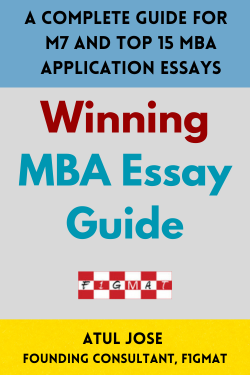
Winning MBA Essay Guide - A Complete Guide for M7 and Top 15 MBA Application Essays
F1GMAT's Winning MBA Essay guide will teach you how to transform your essay into a life journey with trials and tribulations that will move the admission team.
+ Over 245 Sample Essays (Read Previews of F1GMAT's Winning MBA Essay Guide Sample Essays here)
+ Leadership Narratives
+ Review Tips
+ Persuasion Strategies
+ The Secret to "unleashing" your unique voice
+ How to prepare and present for the Video Essay
+ How to write about your Strengths
+ How to write about your Weaknesses
Want to try the individual school Essay Guides before upgrading to the Winning MBA Essay Guide? Try below.
F1GMAT's Essay Guides
- Harvard MBA Essay Guide (20 Sample Essays)
- Stanford MBA Essay Guide (24 Sample Essays)
- Columbia MBA Essay Guide (21 Sample Essays)
- Wharton MBA Essay Guide (15 Sample Essays)
- INSEAD MBA Essay Guide (19 Sample Essays)
- Darden MBA Essay Guide (21 Sample Essays)
- Yale SOM MBA Essay Guide (15 Sample Essays)
- Tuck MBA Essay Guide (15 Sample Essays)
- Haas MBA Essay Guide (18 Sample Essays)
- NYU Stern MBA Essay Guide (15 Sample Essays + 6 Examples - Visual Essay)
- LBS MBA Essay Guide (6 Sample Essays)
- MIT Sloan MBA Essay Guide (6 Sample Cover Letters + 3 Sample Video Statement Scripts + 3 Sample Optional Essays)
- Kellogg MBA Essay Guide (11 Sample Essays)
- Chicago Booth MBA Essay Guide (12 Sample Essays)
- Ross MBA Essay Guide (31 Sample Essays)
- Duke Fuqua MBA Essay Guide (10 Sample Essays + Two 25 Random Things Samples)
- Cambridge MBA Essay Guide (12 Sample Essays)
Want to read the Essay Examples before purchasing the Essay Guides?
Not sure if an MBA Program is right for you? See our Premium Research.
F1GMAT Premium
Salary Trends
Do you want to work with the expert consultant who has guided applicants to M7 and T20 MBA admissions? Sign up now!
F1GMAT's Services
- MBA Application Review (Essay Editing + Resume Editing + Recommendation Letters + All Application Questions)
- Essay Editing (Essays and All Application Questions)
- One Essay Editing (One Essay/One Cover Letter)
- Career Planning and Detailed Profile Evaluation (Find career goals and courses/schools to match your aspirations)
- One School Recommendation Letter Editing Service
- One Supervisor Recommendation Letter Editing Service