On your GMAT, you will encounter 1-3 questions that contain overlapping groups with specific characteristics. You will almost never see more than two characteristics (since you can’t draw 3D on your scratch paper). For illustration, let’s take a look at the following Data Sufficiency example:
Q) Of the 70 children who visited a certain doctor last week, how many had neither a cold nor a cough?
(1) 40 of the 70 children had a cold but not a cough.
(2) 20 of the 70 children had both a cold and a cough.
There are two characteristics (cough and cold) and two categories for each (yes and no), so there are four total categories, as indicated by this matrix:
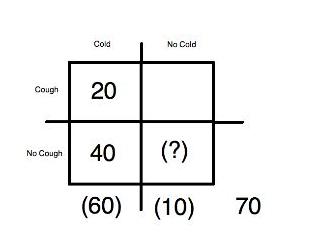
I’ve filled in the given information from both statements, and the parenthetical information is inferred. This clearly lays out the 4 combinations of options. If we sum vertically, we can infer that there are 60 total children with colds. Because there are 70 total children, this also means that 10 do NOT have colds. The bottom-right quadrant cannot be found because we do not know how those 10 children get divided between the two empty boxes. Choice E – together the statements are insufficient.
We may also visualize the question as Venn diagram, in which there are still two characteristics, represented by overlapping circles. You will notice that there are still two undefined regions, so the given information is insufficient.
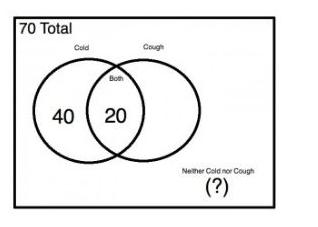
For any Data Sufficiency or Problem Solving Set question, map out the provided information and mark the region that you need to find. Note that there may be implicitly defined regions, such as “60 children have a cold” above. Let’s look at one more example in matrix format.
Q) Each of the dogs in a certain kennel is a single color. Each of the dogs in the kennel either has long fur or does not. Of the 45 dogs in the kennel, 26 have long fur, 17 are brown, and 8 are neither long-furred nor brown. How many long-furred dogs are brown?
1. A. 26
2. B. 19
3. C. 11
4. D. 8
5. E. 6
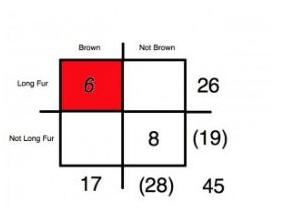
Again, we are provided a small amount of overlapping information and our matrix can simplify our visualization. The parenthetical information is inferred. In fact, in order to have found the correct answer (6) in the top-left quadrant, we had to have derived either of the two empty quadrants.
Of all the types of Quantitative questions on the GMAT, overlapping sets are some of the most like puzzles. This should make you very, very excited. Because who doesn’t like puzzles?
Got a tough set question? Post below or email me at [email protected]!
 About the Author
I am Atul Jose, Founding Consultant of F1GMAT, an MBA admissions consultancy that has worked with applicants since 2009.
For the past 15 years I have edited the application files of admits to the M7 programs: Harvard Business School, Stanford Graduate School of Business, the Wharton School, MIT Sloan, Chicago Booth, Kellogg School of Management, and Columbia Business School, together with admits to Berkeley Haas, Yale School of Management, NYU Stern, Michigan Ross, Duke Fuqua, Darden, Tuck, IMD, London Business School, INSEAD, SDA Bocconi, IESE Business School, HEC Paris, McCombs, and Tepper, plus other programs inside the global top 30.
My work covers the full MBA application deliverable: career planning and profile evaluation, application essay editing, recommendation letter editing, mock interviews and interview preparation, scholarship and fellowship essay editing, and cover letter editing for funding applications. Full bio with credentials and admit history is here.
I am the author of the Winning MBA Essay Guide, the best-selling essay guide covering M7 MBA programs. I have written and updated the guide annually since 2013, which makes the 2026 edition the thirteenth.
The reason I still write and edit essays every cycle: a good MBA essay carries a real applicant's voice. Writing essays for F1GMAT's Books and Editing essays weekly is how I stay calibrated to what current admissions committees respond to.
Contact me for school selection, career planning, essay strategy, narrative development, essay editing, interview preparation, scholarship essay editing, or guidance documents for recommendation letters.