 Good news, test takers! You can pass the GMAT! Most of the questions are not that difficult. The difficulty in the test is in taking a mid-level question, (5x2 = 10) and rephrasing it in a more difficult way. (5 men walk into a bar. The bartender gives each man a beer for each of their hands. How many beers does the bartender distribute all together?) There is one exception to the rule, though: Absolute value inequalities.
It’s a little tough, but not impossible to figure out absolute value inequalities!
We’ll start with absolute value expression’s basic definitions, mathematically and conceptually. Then we’ll use that basic understanding to solve equations and inequalities including absolute value expressions. Finally, we’ll deal with a concept-based application of the absolute value inequalities on the GMAT. Let’s go!
Absolute positive - Everybody knows that |9|=9 and|-9|=9. What’s so special about those slanted lines? How and why does it neutralize a number? Those bars are the measure of the distance of the number within the bars and zero. -9 and 9 are both 9 units away from 0. Picture it!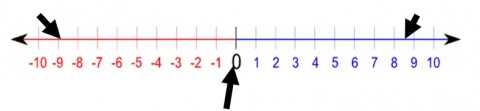
Let’s look at it those two ways
1) The number within the bars will definitely turn positive and
2) The distance from zero to the number is our basis for digging deeper into absolute value.
This concept becomes difficult when a variable, as opposed to a number, is placed within those bars, |u|. Shouldn’t |u| be equal to u? There’s no sign in front of the u, so absolute values says this u should be positive…but this u could actually be negative!
When dealing with absolute values of variables, know these constants
1) the expression (number or variable) may have a positive sign [+]
2) the expression (number or valuable) may have a negative [-] sign.
The Bottom Line: Numbers or variables with the absolute value bars can be negative or positive.
Solving absolute values
Step one: Remove the bars…but before you do that, consider the possibility of a negative or positive scenario. |u| + 6 =10
Scenario 1: If u is positive, simply drop the absolute value bars and rewrite the equation as u+6=10, u =4
Remember that if u is greater than 0, then u=4
u>0, then u=4
Scenario 2: If u is negative, removing the absolute value bars negates [-] the expression. The equation is then written (-u)+8=12, u=-4
u<0, u=-4
Now remember the “5 men walking into a bar” comparison. They want to complicate a simple mid-level equation here, so be very careful. |u+1| =8
SOLVE
Scenario 1:
Remember that
u+1 is positive, u+1=8, so u=7
Don’t forget that if
u>-1, then u=7
Scenario 2:
(u+1) is negative (this time)
Then –(u+1)=8 and u=-9.
Therefore, u<-1, and u=-9
Did you see in those two examples that there are two solutions to the GMAT inequalities with absolute value equations?
This is because a variable absolute expression depends on the value (positive or negative.) Each variable has a breaking point, known as the critical point. The critical point is the zeroing point of the values in the absolute value bars.
For |u|, the critical|zeroing point is 0.
All u’s to the right of the 0 on the number line changes the variable:
|u| to u
All the u’s to the left of the number line changes the variable: |u| to (-u)
For the expression, |u-2|, 2 is the critical point.
For the expression, |2u+3|, -3, 2 is the critical point.
The critical point is important because it tells the numerical range that makes each equation true. GMAT inequalities with absolute values are one of those topics that teachers use to try and trick unsuspecting students. With a little bit of direction and awareness, you’ll be fine. You only need a little bit of knowledge and the fundamentals. You’ll solve these no-so-tricky problems with ease.
 About the Author
I am Atul Jose, Founding Consultant of F1GMAT, an MBA admissions consultancy that has worked with applicants since 2009.
For the past 15 years I have edited the application files of admits to the M7 programs: Harvard Business School, Stanford Graduate School of Business, the Wharton School, MIT Sloan, Chicago Booth, Kellogg School of Management, and Columbia Business School, together with admits to Berkeley Haas, Yale School of Management, NYU Stern, Michigan Ross, Duke Fuqua, Darden, Tuck, IMD, London Business School, INSEAD, SDA Bocconi, IESE Business School, HEC Paris, McCombs, and Tepper, plus other programs inside the global top 30.
My work covers the full MBA application deliverable: career planning and profile evaluation, application essay editing, recommendation letter editing, mock interviews and interview preparation, scholarship and fellowship essay editing, and cover letter editing for funding applications. Full bio with credentials and admit history is here.
I am the author of the Winning MBA Essay Guide, the best-selling essay guide covering M7 MBA programs. I have written and updated the guide annually since 2013, which makes the 2026 edition the thirteenth.
The reason I still write and edit essays every cycle: a good MBA essay carries a real applicant's voice. Writing essays for F1GMAT's Books and Editing essays weekly is how I stay calibrated to what current admissions committees respond to.
Contact me for school selection, career planning, essay strategy, narrative development, essay editing, interview preparation, scholarship essay editing, or guidance documents for recommendation letters.